Blog
Articles
OpenMetadata data lineage alternatives compared (2026)

OpenMetadata data lineage alternatives compared (2026)

Articles
November 20, 2026
Team Foundational
Subscribe to our Newsletter
Get the latest from our team delivered to your inbox
Thank you! Your submission has been received!
Oops! Something went wrong while submitting the form.
Ready to get started?
Try It Free
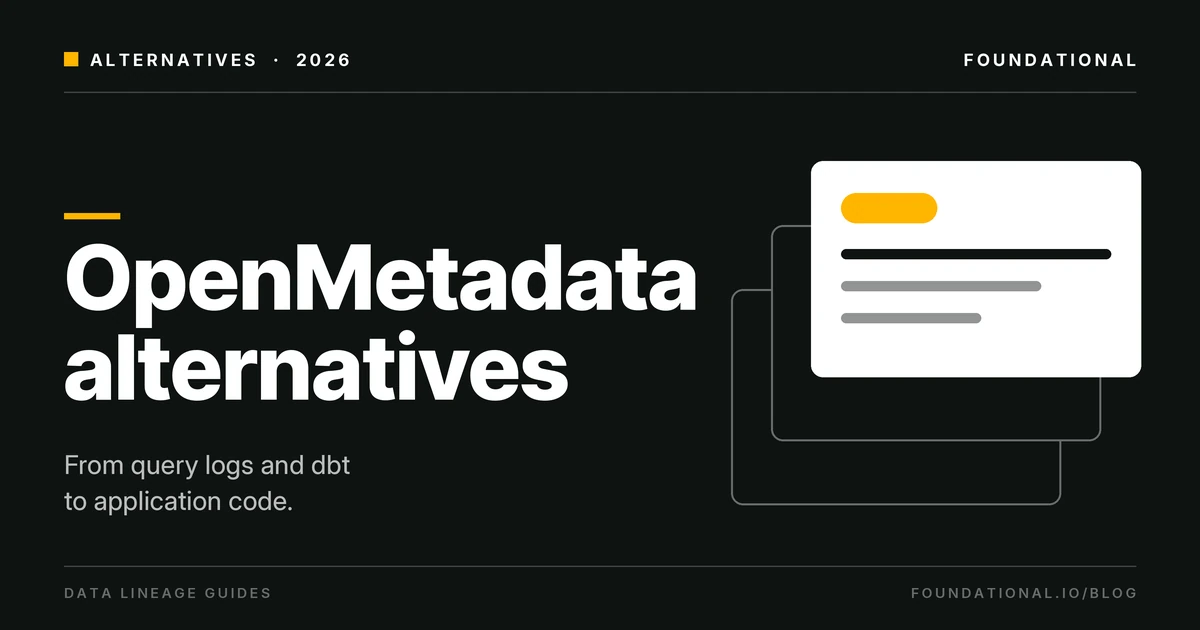
Near-black cover with the headline "OpenMetadata alternatives" and a stack of metadata cards with a yellow tag on the front card.

OpenMetadata is an open-source metadata platform that builds lineage from query logs, view definitions, dbt manifests and OpenLineage events. Alternatives like Foundational, DataHub, Atlan and Collibra differ in what each tool reads, from SQL and tool APIs to the application code that writes each column.

What an OpenMetadata alternative has to trace

A Python orders service starts writing order_total in cents instead of dollars. A Spark job sums it into daily_revenue, a dbt model reshapes it in Snowflake, and a Tableau dashboard shows it to finance. Revenue jumps a hundredfold the next morning. Nobody knows which change caused it.

Lineage inferred from query logs only reflects queries that already ran. Lineage read from code also shows what a change will touch before it runs. An OpenMetadata alternative needs column-level lineage across four kinds of systems:

  • Application and mainframe code
    The Python, Java, TypeScript, Go, Scala or COBOL programs that write the tables your pipelines read.
  • Pipelines and transformations
    The Spark, Airflow and dbt jobs that reshape those tables.
  • Warehouses and databases
    The Snowflake, BigQuery, Databricks or PostgreSQL tables where each column lands.
  • BI and AI consumers
    The dashboards, reports and AI agents that read the final columns.

Each tool below documents a way to add lineage for a system it doesn't read automatically, through APIs, events or manual edits. For the general shortlist, see our comparison of the best data lineage tools. For a DataHub-first view, see our DataHub alternatives guide.

OpenMetadata alternatives compared

All five tools build lineage, but they read different parts of the stack.

Tool How it captures lineage Coverage across your stack Where it stops
Foundational Static code analysis, plus warehouse and BI metadata Application and mainframe code, pipelines, warehouses and BI A repository or system has to be connected
OpenMetadata Query logs, view DDL, dbt manifests, OpenLineage events, manual edits Databases, dashboards and pipelines from supported connectors Query-log lineage workflow covers a limited set of connectors
DataHub Automatic extraction, OpenLineage events and manual edits Snowflake, BigQuery, dbt, Looker, Power BI and other supported tools Systems without a connector or events need manual lineage
Atlan Query-history SQL parsing, tool APIs and open lineage APIs Connected warehouses, dbt and BI tools only On Snowflake, only direct procedure and UDF calls are captured
Collibra Parses SQL from supported sources, plus OpenLineage JDBC sources, ETL tools and BI tools it supports Dynamic queries and JSON or struct access aren't supported

How each alternative builds lineage

Foundational

Foundational is a data & AI governance platform. It statically analyzes code to build the data flow graph at the column level. It covers Python, Java, TypeScript, Go, Scala, Spark, and COBOL with JCL, copybooks and Db2, among others. That code sits in the same data flow graph as Airflow, Snowflake, BigQuery, Databricks, Looker, Tableau and Power BI.

Foundational data lineage view with the RAW_ORDERS table in a Postgres database flowing into ORDER_HISTORY in Snowflake and on to SALES_OPPORTUNITIES in a Looker sales dashboard.
A sample from Foundational's column-level lineage view: a Postgres table traced through Snowflake to a Looker dashboard.

Because the lineage comes from code, it includes code and tables that haven't run yet. In the order_total example, Foundational follows the field from the Python service through the Spark job and the dbt model to the Tableau dashboard. Finance sees why revenue moved and which other dashboards read the same column. It traces all of this from source code, without accessing your data.

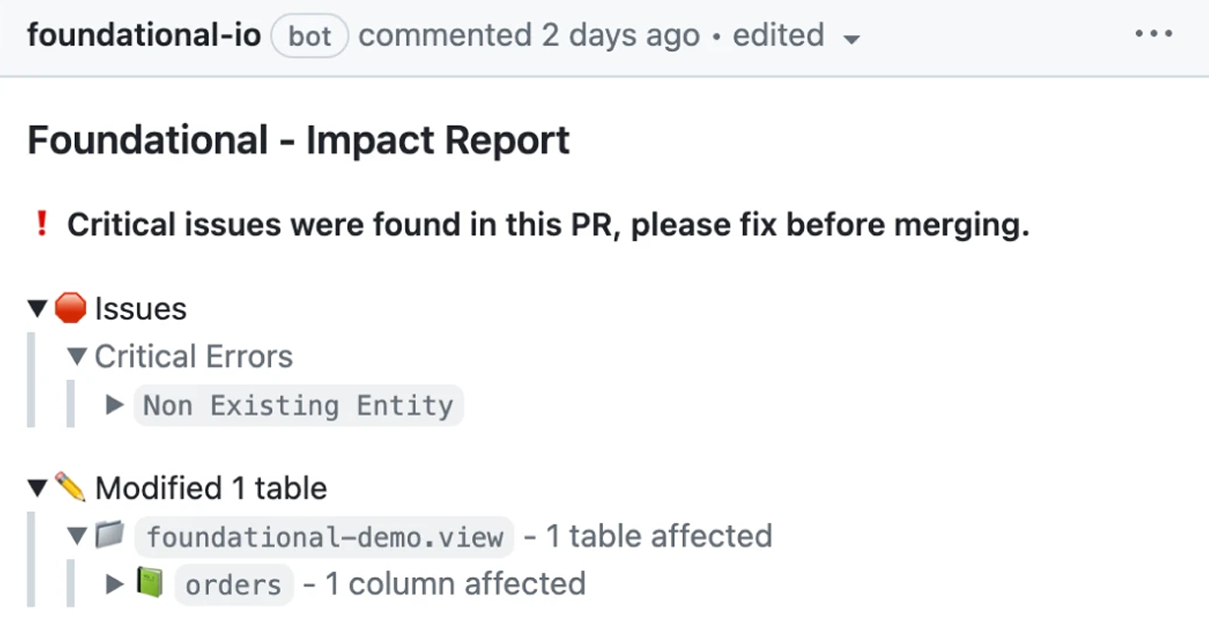
Foundational also runs impact analysis on the pull request. It adds a check and a comment in GitHub, GitLab, Bitbucket or Azure DevOps that lists the tables, dbt models, dashboards and owners a change would affect.

A pull request titled Sales table update #6442 with a Foundational bot comment showing a Breaking Schema finding.
A Foundational comment on a pull request, flagging a breaking schema change before it merges.

Foundational IQ adds agents grounded in the same data flow graph. They answer governance questions, create reports and open pull requests for tasks such as data quality and code checks. The platform also covers ontology and catalog on the data flow graph, so replacing OpenMetadata doesn't mean giving up the catalog.

Fits when you want column-level lineage across application code, Spark, dbt and BI, impact checks before code ships, and one platform for lineage, ontology and catalog.

OpenMetadata

OpenMetadata is an open-source metadata platform released under the Apache 2.0 license. Collate offers it as a managed service. OpenMetadata tracks lineage for databases, dashboards and pipelines. During metadata ingestion, it parses view definitions into table- and column-level lineage. A Lineage Agent reads query logs over a lookback period you set, on a limited set of connectors such as BigQuery, Snowflake, MSSQL, Redshift, ClickHouse, PostgreSQL and Databricks. For other databases, you can feed it query logs exported to a CSV file.

It also parses dbt manifests, including column-level lineage, though it skips models that aren't materialized. Pipeline lineage comes from Airflow, where you declare inlets and outlets, and from Fivetran, Dagster and Airbyte. Spark jobs send lineage through the OpenLineage Spark listener. Any producer can send OpenLineage events over HTTP, Kafka or Kinesis. You can add the rest through the Python SDK or by hand. The column-level view supports impact analysis before you change a column.

Fits when you want an open-source platform you run yourself, and most of your lineage lives in supported warehouses, dbt and pipeline tools.

DataHub

DataHub is an open-source data catalog with lineage. It automatically extracts table- and column-level lineage from BigQuery, Snowflake, dbt, Looker, Power BI and other supported tools. It also ingests OpenLineage events through a REST endpoint and through Spark and Airflow plugins. If a system has no automatic extractor, DataHub says you can add lineage with its APIs and SDKs, or edit it by hand in the UI.

Fits when you want an open-source catalog and can run its connectors, plugins or event emitters.

Atlan

Atlan builds lineage by parsing SQL from query history, crawling tool APIs and ingesting lineage through open APIs. The documented SQL-parsing path includes Snowflake, BigQuery, Redshift and dbt. The API path includes sources such as Databricks Unity Catalog, Looker, Tableau and Power BI. On Snowflake, only direct stored procedure and UDF calls are captured. Dynamic or nested calls, and transformations that run outside Snowflake, aren't captured on that path.

Fits when you want a catalog with lineage across the warehouses, dbt projects and BI tools you already connect.

Collibra

Collibra Data Lineage automatically extracts lineage from the sources, ETL tools and BI tools it supports. It also supports the OpenLineage standard. Technical lineage is available at table and column level for those supported inputs, including JDBC data sources. You can add custom technical lineage for sources it doesn't list. Its SQL parser doesn't support DML on JSON or structs, or triggers, cursors and dynamic queries. Collibra says that list isn't exhaustive.

Fits when you already use Collibra for stewardship and want technical lineage from the sources it supports.

How to choose an OpenMetadata alternative

Start with the question you need answered, then check which tool can answer it.

  • Does order_total pass through application code?
    If a Python, Java, TypeScript, Go or Scala step sits upstream of the warehouse, you need a tool that reads that code, or events someone emits for it. Mainframe COBOL and ETL tools need the same check. Our IBM Manta alternatives and Informatica alternatives guides cover those cases.
  • Do you need the impact before code merges?
    A tool that reads code can show the effect of a change still in review. A tool that works from query logs, manifests or events shows it after the next run. Our data impact analysis tools comparison goes deeper on this question.
  • Which warehouses, pipelines and BI tools have to appear?
    Check each tool's supported-source list for your stack. If Snowflake is your main warehouse, see how Snowflake column-level lineage tools compare.
  • Do you want to host it yourself?
    OpenMetadata and DataHub are open source, so you can deploy them yourself. OpenMetadata also comes as a managed service through Collate. DataHub offers DataHub Cloud.
  • Are you replacing OpenMetadata?
    Check that the new tool covers the data catalog and ontology as well as lineage. Foundational covers the catalog and ontology on the same data flow graph.

Frequently asked questions

What are the best OpenMetadata alternatives for data lineage?

Foundational, DataHub, Atlan and Collibra are the main alternatives, and all four build lineage from the systems they connect to.

They differ in what they read. DataHub, Atlan and Collibra build lineage from connectors, SQL, tool APIs and events. Foundational statically analyzes code to build the data flow graph, from application code in Python, Java, TypeScript, Go and Scala through Spark, dbt, warehouses and BI. It also covers COBOL on the mainframe.

Is Foundational the right OpenMetadata replacement for my team?

Yes, if you want lineage mapped across systems with source-code context, so it stays current as the code changes.

Foundational is a data & AI governance platform. It adds impact analysis on the pull request, ontology and catalog on the data flow graph, plus data contracts, and agents for governance, data quality and code checks. If your priority is an open-source platform that you host and extend yourself, OpenMetadata is built for that.

Does OpenMetadata support column-level lineage?

Yes. OpenMetadata builds column-level lineage from view definitions, from query logs read by its Lineage Agent, and from dbt manifests. Spark jobs add it through OpenLineage events. You can edit column links by hand.

Foundational statically analyzes code to build the data flow graph at the column level, so the Python, Java or Go service that writes a column appears in the graph from the source code itself.

How does OpenMetadata lineage from query logs differ from lineage built from code?

OpenMetadata's Lineage Agent reads the query log for a lookback period you set and parses those queries. For databases outside its list, you can export query logs to a CSV file and run that workflow. Either way, the lineage reflects queries that already ran.

Foundational statically analyzes code to build the data flow graph, so lineage includes code and tables that haven't run yet and shows impact in the pull request before the change merges.

Can these tools show impact before a pull request merges?

All five show downstream impact from the lineage already in their views. OpenMetadata, DataHub and Atlan document impact analysis. Collibra shows downstream effects at table, column and report level.

Foundational runs impact analysis on the pull request itself. It adds a check and a comment in your source control that lists the tables, dbt models, dashboards and owners a change would affect, so reviewers see it before the change merges.

Which languages and platforms does Foundational cover beyond SQL and dbt?

Foundational statically analyzes code in Python, Java, TypeScript, Go, Scala, SQL and many more languages, plus Spark and mainframe COBOL with JCL, copybooks and Db2.

It also covers pipeline tools such as dbt, Airflow and Informatica, warehouses such as Snowflake, BigQuery and Databricks, and BI tools such as Looker, Tableau and Power BI. Coverage starts once each repository and system is connected. Foundational doesn't access your data.

code snippet <goes here>
<style>.horizontal-trigger {height: calc(100% - 100vh);}</style>
<script src="https://cdnjs.cloudflare.com/ajax/libs/gsap/3.8.0/gsap.min.js"></script>
<script src="https://cdnjs.cloudflare.com/ajax/libs/gsap/3.8.0/ScrollTrigger.min.js"></script>
<script>
// © Code by T.RICKS, https://www.timothyricks.com/
// Copyright 2021, T.RICKS, All rights reserved.
// You have the license to use this code in your projects but not to redistribute it to others
gsap.registerPlugin(ScrollTrigger);
let horizontalItem = $(".horizontal-item");
let horizontalSection = $(".horizontal-section");
let moveDistance;
function calculateScroll() {
 // Desktop
 let itemsInView = 3;
 let scrollSpeed = 1.2;  if (window.matchMedia("(max-width: 479px)").matches) {
   // Mobile Portrait
   itemsInView = 1;
   scrollSpeed = 1.2;
 } else if (window.matchMedia("(max-width: 767px)").matches) {
   // Mobile Landscape
   itemsInView = 1;
   scrollSpeed = 1.2;
 } else if (window.matchMedia("(max-width: 991px)").matches) {
   // Tablet
   itemsInView = 2;
   scrollSpeed = 1.2;
 }
 let moveAmount = horizontalItem.length - itemsInView;
 let minHeight =
   scrollSpeed * horizontalItem.outerWidth() * horizontalItem.length;
 if (moveAmount <= 0) {
   moveAmount = 0;
   minHeight = 0;
   // horizontalSection.css('height', '100vh');
 } else {
   horizontalSection.css("height", "200vh");
 }
 moveDistance = horizontalItem.outerWidth() * moveAmount;
 horizontalSection.css("min-height", minHeight + "px");
}
calculateScroll();
window.onresize = function () {
 calculateScroll();
};let tl = gsap.timeline({
 scrollTrigger: {
   trigger: ".horizontal-trigger",
   // trigger element - viewport
   start: "top top",
   end: "bottom top",
   invalidateOnRefresh: true,
   scrub: 1
 }
});
tl.to(".horizontal-section .list", {
 x: () => -moveDistance,
 duration: 1
});
</script>

See your lineage beyond the query log

Bring one column from your stack and we'll trace it from the code that writes it to the dashboard that shows it.

See your lineage beyond the query log

Bring one column from your stack and we'll trace it from the code that writes it to the dashboard that shows it.

See your lineage beyond the query log

Bring one column from your stack and we'll trace it from the code that writes it to the dashboard that shows it.

Share this post
Subscribe to our Newsletter
Get the latest from our team delivered to your inbox
Thank you! Your submission has been received!
Oops! Something went wrong while submitting the form.
Ready to get started?
Try It Free

Governance that starts at the source.