See the impact of every change across all repositories and validate pull requests early so data stays reliable across the organization.
Data teams move fast, but change without context creates real downstream risk.
Code changes ripple through models, pipelines, and dashboards. Most teams cannot see what each pull request will affect until it breaks something important.
Engineers trace lineage by hand just to understand whether a schema change is safe. Reviews stall, incidents slip through, and delivery slows.
Executives lose trust when dashboards conflict or fail. Every broken metric creates churn for analysts and decision makers.
Catalogs and observability tools react after problems appear. Teams need validation at the point of change, not after damage is visible.
Teams need a reliable method to understand upstream and downstream effects for every code change. This starts where work happens inside the pull request. Each change is analyzed automatically, revealing exactly which models, tables, columns, and dashboards depend on the update. Engineers see the impact instantly, fix issues early, and merge with confidence.


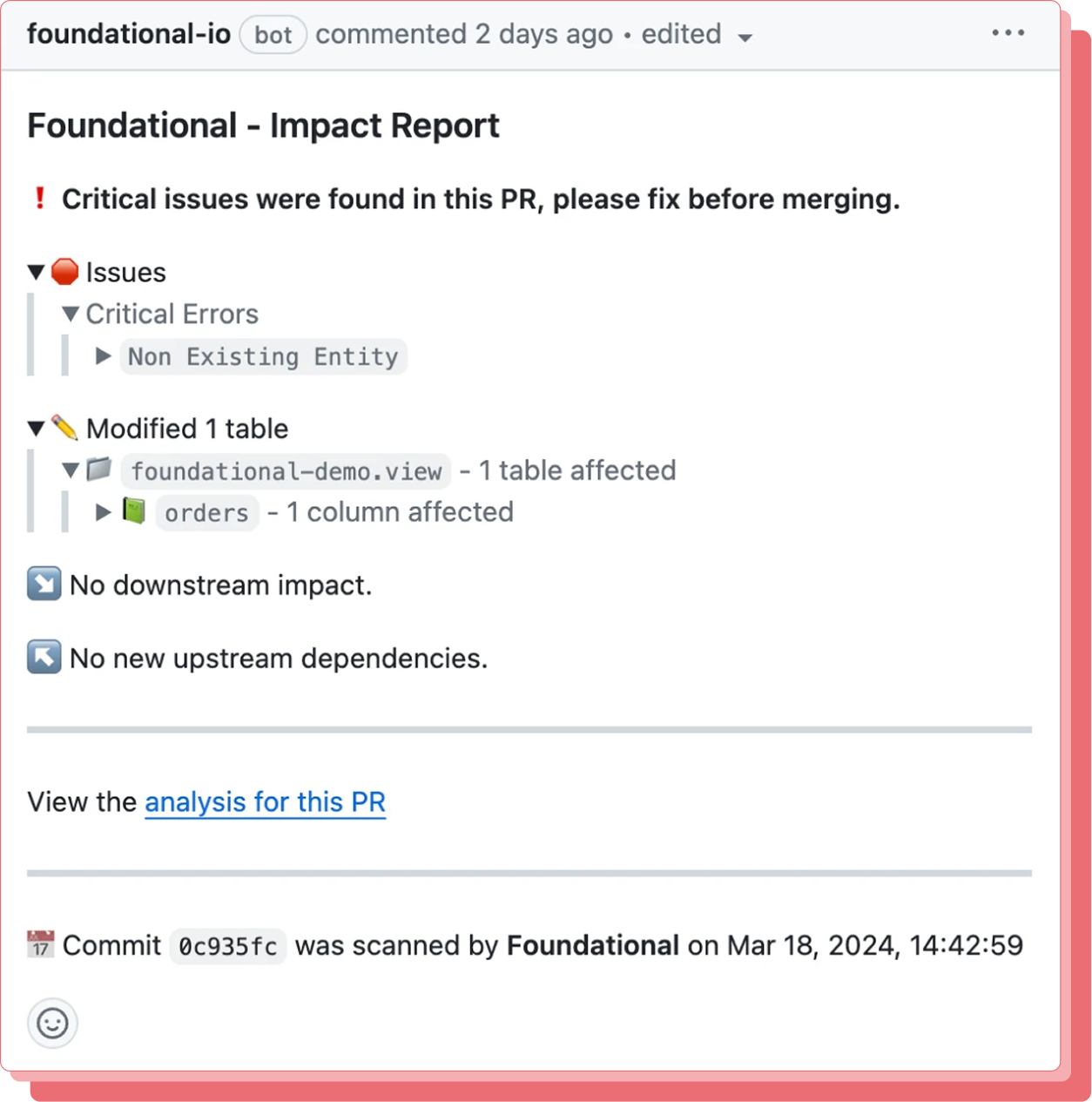
See how owner notifications and optional CI/CD blocks keep teams aligned and issues contained.
Early clarity lets teams resolve risks fast, reduce incidents, and keep delivery moving.

Every pull request that touches data is scanned within seconds. Reviewers see a clear summary of affected assets, owners, and risks so they can move faster with full context.
Deep lineage connects code to downstream models and dashboards. Teams understand exactly which metrics and reports depend on every column, transformation, and table.

Impact results appear directly in the tools teams already use. No switching contexts and no scattered conversations. Engineers collaborate around one shared understanding of risk.

Manual tracing disappears. Reviews accelerate. Engineers spend their time shipping improvements instead of chasing breaking changes.

Stakeholders trust the numbers. With early validation, dashboards stay accurate and decisions stay aligned.

Owners see how their work intersects. Data engineers, analytics engineers, and analysts share a unified view of lineage and impact.

Teams keep delivery velocity high without risking data quality. Pre-merge validation enables modern development practices with fewer incidents.