
Organizations lose time, trust, and money when changes slip through without oversight. Impact analysis surfaces these risks early so teams can prevent operational and business impact.


Changes are analyzed before merging to reveal affected assets, owners, and business implications, enabled by a code first approach unmatched in the market.


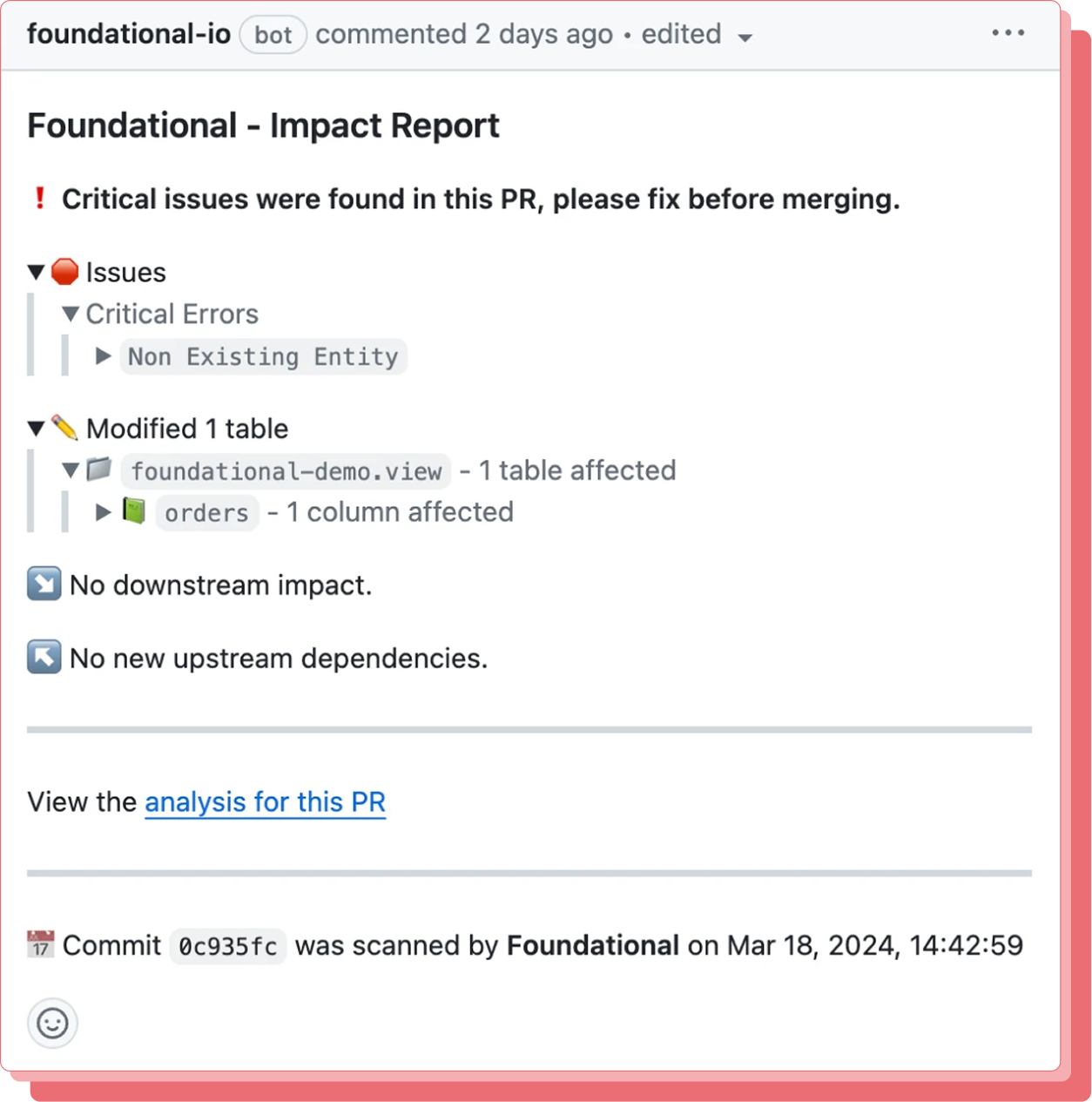
Gain clarity on what will break, who is impacted, and how to resolve issues before changes reach production.

Every pull request is scanned in seconds with no manual workflow changes.
See all downstream dependencies and affected owners in one place.

Identify schema changes, removed fields, and type mismatches automatically.

Automatically inform the responsible teams in the systems they use every day, ensuring efficient triage and resolution.
Stop unexpected breaks in dashboards, create consistent contracts between teams, and enforce rules that safeguard production AI from unstable inputs.
Stop unexpected column or logic changes from breaking downstream dashboards, metrics, and production models.
Define expected inputs, outputs, and behaviors at every data interface so teams avoid accidental breaks and unowned changes.
Ensure data feeding models remains accurate and stable by enforcing rules that prevent harmful upstream changes.



Give your team the clarity to prevent incidents and deliver trusted changes on every deployment.
Foundational is a new way of building and managing data: We make it easy for everyone in the organization to understand, communicate, and create code for data.

Impact analysis works by using data lineage to understand how changes propagate across downstream tables, dashboards, and AI systems. By analyzing dependencies before changes are deployed, teams can assess risk and prevent breaking downstream consumers.
Impact analysis connects directly to GitHub, GitLab, Bitbucket, and Azure DevOps. No new UI is required and teams continue working in their existing workflow. Installation takes minutes and results appear directly in the pull request.
Yes. It integrates with GitHub Actions, Jenkins, CircleCI, GitLab CI, and Azure Pipelines. Teams can enforce quality gates, require approvals, or block high risk merges automatically.
Notifications can be sent to Slack, Microsoft Teams, email, or PagerDuty. Each alert includes the downstream assets affected, the risk level, and the owners who should review the change.
Yes. The analysis engine maps complete data dependencies, showing how a code change affects tables, models, transformations, BI objects, and metrics. This prevents broken dashboards and failed pipelines.
Yes. The analysis engine is optimized for large repositories and complex data ecosystems. It handles high pull request volume, deep dependency chains, and heavy workshop pipelines without performance issues.


