Table of Content

Subscribe to our Newsletter
Get the latest from our team delivered to your inbox
Thank you! Your submission has been received!
Oops! Something went wrong while submitting the form.
Ready to get started?
Try It Free

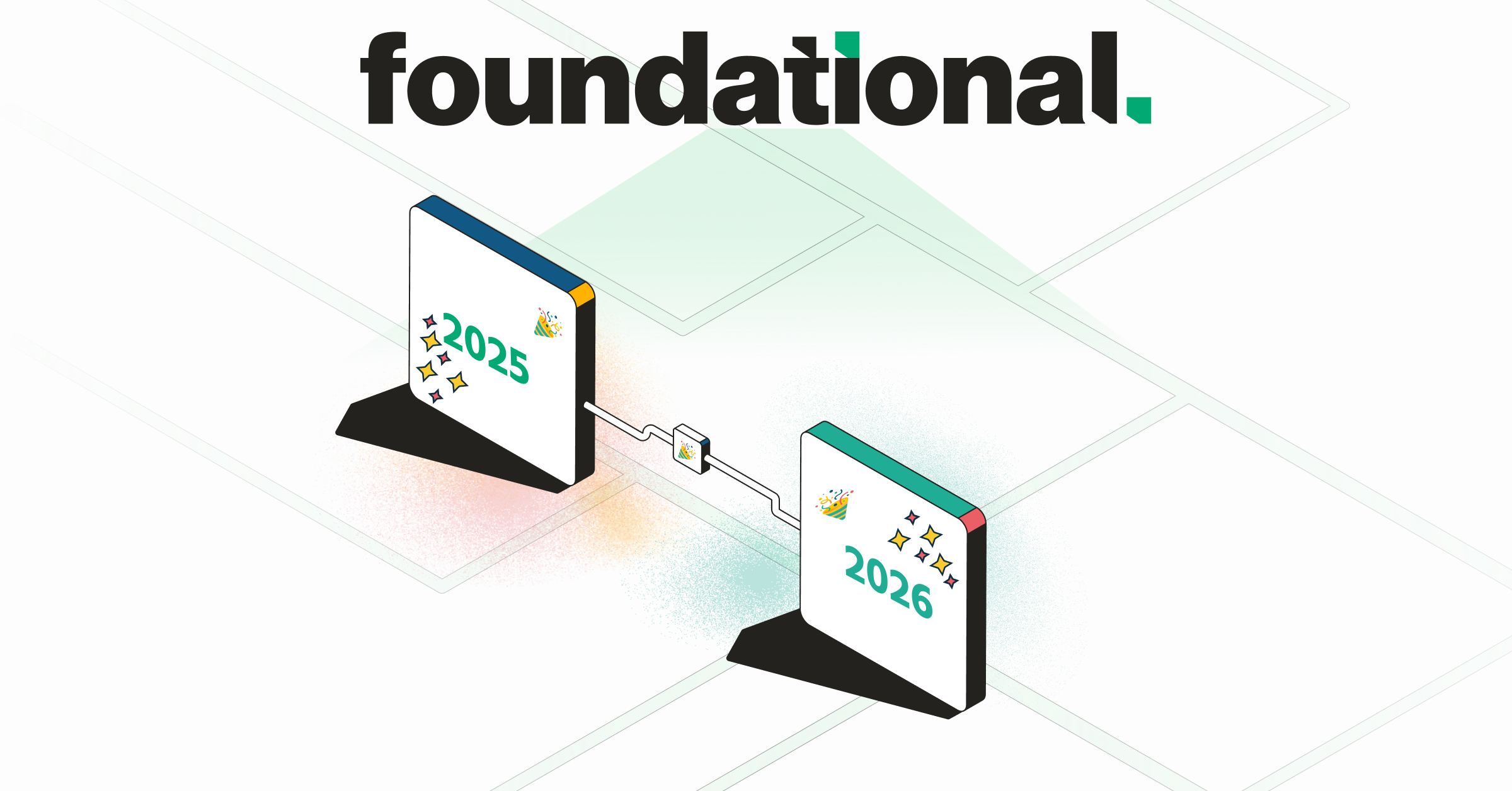
As we come to the close of 2025, one of the clearest observations is just how quickly the data and AI landscape is changing. The push for AI in production is stronger than ever. Data environments continue to grow in size and complexity. AI products are steadily moving from experimentation into maturity. Along the way, expectations around trust, reliability, and governance have continued to rise.
Throughout 2025, Foundational continued to strengthen data and AI governance for the AI era by focusing our efforts where change actually happens, at the source code. And there’s a lot more code now. This approach is core to how Foundational delivers proactive governance across enterprise environments (learn more). The focus was not on chasing trends, but on reinforcing what durable governance looks like when data and AI are central to how organizations run.
This post reflects on the milestones we delivered in 2025, the patterns we observed across customer environments, and how those signals are shaping what data and AI governance needs to support in 2026.
A consistent priority throughout the year was ensuring governance works across the environments teams actually operate, from established on-premises databases to the newest cloud systems. Enterprise tech stacks span multiple platforms, services, databases, analytics tools, and increasingly, AI systems. Governance needs to function across all of them without adding friction.
Key milestones in this area included:
These investments reflect a simple principle. Governance is most effective when it aligns with existing workflows rather than requiring new ones.
Another focus area was data quality. Many teams rely on point in time checks or alerts tied to specific warehouse tables. What we continued to see was the value of more precise signals that reflect how data is expected to behave over time, and the ability to scale that to large environments while minimizing alert fatigue
Key improvements included, building on Foundational’s data quality and observability capabilities:
Pre-deploy semantic checks extended that visibility earlier in the development lifecycle. This made it easier to understand the impact of change before it reached production, reducing rework and shortening feedback loops.
As data environments grow, context becomes increasingly important. Monitoring alone cannot answer the questions teams care about most. What changed. Why it matters. Who is affected.
Throughout the year, we expanded the Foundational Data Graph with a focus on:
This shared context supports clearer conversations and better decisions across teams. You can explore how this works in Foundational’s lineage analysis experience, which shows how source code level lineage drives proactive governance across the data stack.
We also continued to invest in governance that integrates directly into the tools and workflows teams already use.
Code based lineage expanded into additional languages such as Java and C++, new orchestration frameworks, Python notebooks, and non relational databases such as MongoDB and Couchbase. This made it easier to understand change across the full lifecycle, from source code through downstream consumption.
At the same time, we’ve made lineage, metadata, and documentation available directly within existing BI tools. This helped business users build confidence in the data they rely on without needing to leave their existing workflows.
AI adoption continued to accelerate in 2025, though teams remain at different stages of maturity. Rather than treating AI governance as a separate discipline, our focus has been on extending existing governance foundations to support AI systems, including production AI workflows that depend on trusted data and governed change:
All the core data governance fundamentals, including lineage, data quality, access controls, and policy enforcement, play a role in AI governance as data flows into models and applications. Early AI assisted workflows helped teams scale tasks like documentation and discovery while keeping humans in the loop.
Industry research throughout the year reinforced several consistent themes, echoed by leading analyst firms such as Forrester, Gartner, and 451 Research:
Together, these signals point to a growing consensus around the importance of foundational governance capabilities, even as organizations take different paths to maturity. For example, Forrester’s Predictions 2026 highlight trust and governance as decisive factors for scaling AI responsibly (Forrester Predictions 2026).
While approaches vary, several patterns appear consistently among teams navigating complexity with confidence.
They tend to:
In 2026, governance will continue to mature alongside data and AI systems. We expect to see deeper lineage across data and AI workflows, richer context for understanding change, and governance capabilities that extend further into development, analytics, and AI tooling. The need for lineage that spans across tools, applications, and systems to provide full visibility is stronger than ever. And in that universe, Foundational’s code analysis is key.
As AI becomes more integrated into everyday operations, governance will increasingly serve as an enabling layer that helps teams move forward with confidence.
Three challenges show up consistently across the enterprise teams we work with heading into 2026.
Provenance for model inputs. Model risk teams can explain what a model does. Fewer can explain, with evidence, exactly which data fed a given model version and where that data originated. SR 26-2 and OCC Bulletin 2026-13 both raise the bar on this specific gap for regulated institutions, and the same evidence expectation is spreading to less regulated industries as boards ask the same question.
AI generated code entering the pipeline. A growing share of pipeline code is now written or co-written by AI. That code changes schemas and joins as confidently as human written code, and often faster, which means governance checks that used to run on a human review cadence now need to run on every commit.
Governance that stops at the warehouse. Catalog tools see only where data lands. They do not see the Python pipelines, ORM layers, and application code that produced it. When a model input traces back through an application layer a catalog never indexed, the lineage trail ends exactly where the audit question begins.
Foundational is a data and AI governance platform built to close that gap. By analyzing source code directly rather than warehouse query logs, deterministic lineage extends upstream through the pipelines and application code that catalog based tools cannot see.
2025 reinforced an important lesson. Durable governance is built intentionally, grounded in real systems, and designed to scale with change.
At Foundational, we are building a data and AI governance platform with governance anchored at the source code rather than applied after the fact, using source code analysis to see what catalog tools cannot. That approach is what trusted, scalable data and AI operations will require in 2026 and beyond.
A short list of the most influential pieces shaping how organizations are preparing for 2026.
The three that come up most are proving provenance for the data feeding AI models, keeping pace with AI generated changes to data pipelines, and closing the visibility gap left by catalog tools that only see data once it reaches the warehouse. Regulatory guidance like SR 26-2 and OCC Bulletin 2026-13 has made the first challenge a compliance requirement rather than a best practice for regulated industries.
In 2025, most organizations were still establishing basic lineage and metadata practices. In 2026, those practices are being tested directly against AI specific requirements: model input provenance, agent reliability, and evidence that governance holds up when a meaningful share of pipeline code is AI generated rather than human written.
SR 26-2 superseded SR 11-7 in April 2026 and narrowed the formal scope of model risk management for banks, explicitly excluding generative and agentic AI from that formal scope. That does not remove the governance obligation. It shifts responsibility for governing generative and agentic AI models onto the institution's own data and AI governance program rather than the model risk framework.
Catalog tools index data after it lands in the warehouse, which means they can only show where data ended up, not where it originated. AI governance requires tracing a model input back through the Python pipelines, ORM layers, and application code that produced it, and that is source code catalog tools never analyze.
Start with provenance for the data feeding the highest risk models, the ones used in regulated decisions or customer facing agents. Establish deterministic lineage back through the full pipeline and application layer for those models first, then extend coverage outward rather than trying to govern every dataset at once.