Table of Content

Subscribe to our Newsletter
Get the latest from our team delivered to your inbox
Thank you! Your submission has been received!
Oops! Something went wrong while submitting the form.
Ready to get started?
Try It Free

You rename customer_id to account_id in a dbt model, every test passes, and the PR merges. The next morning, the Looker dashboard your sales team checks first shows an error, because it still asks for customer_id. You can catch that break before you merge with impact analysis on the pull request, which lists the dashboards reading your change.
So why didn't anything catch it? Your CI job did its part. dbt Cloud CI (dbt Labs now calls the product the dbt platform) builds and tests the models you changed, plus everything downstream of them, in a temporary schema, then reports the job status back to GitHub, GitLab, or Azure DevOps. Every model that used customer_id was updated in the same PR, so the status came back green, and accurately so: the project still builds. What the status can't tell you is who reads those models once the data leaves dbt, and the sales dashboard lives on the other side of that line.
The dashboard points at your table by name and asks for each column by name, so to the dashboard, the rename looks like customer_id disappeared overnight. dbt never knew the dashboard existed, because nothing in the project told it.
You can tell it. dbt lets you declare dashboards as exposures in YAML, though someone has to add each dashboard and keep the list current. Automatic exposures are documented only for Tableau on Enterprise plans, so a Looker dashboard like this one still has to be declared by hand. Even then, exposures show up in Catalog rather than on the pull request, so the reviewer looking at your rename wouldn't see them.
That points to what would have helped: lineage that reaches into Looker and gets checked while the PR is still open, when renaming the field back or warning the dashboard's owner is still cheap.
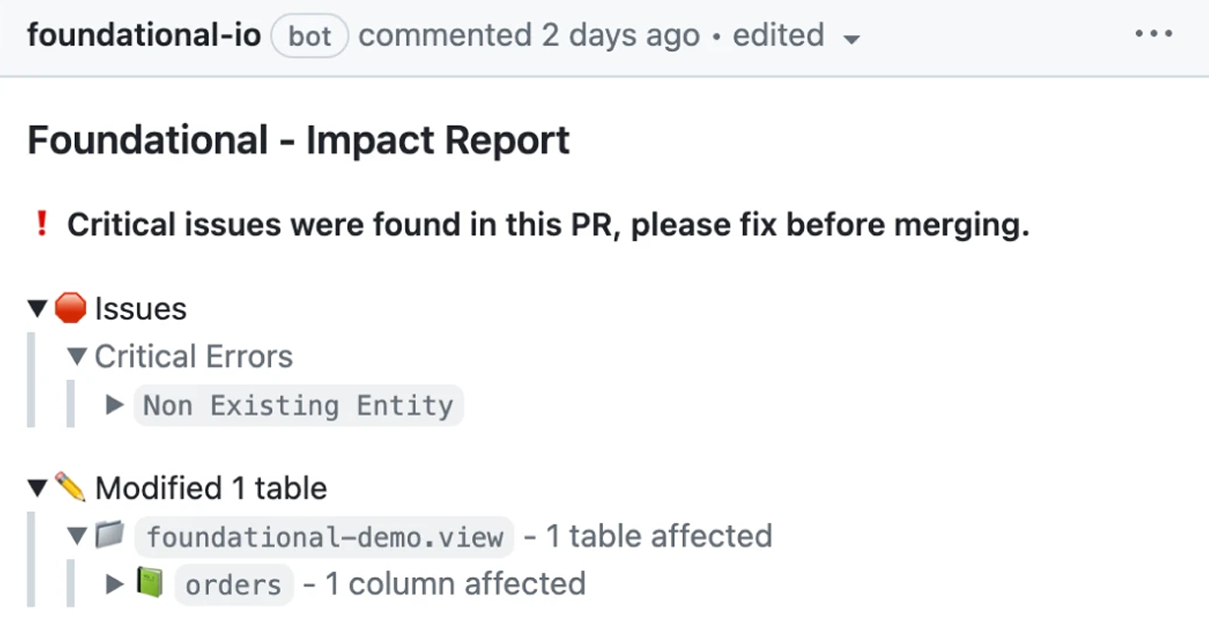
Here's how that looks with Foundational, using the same rename. Foundational compares a column-level lineage graph before and after your change and writes the result onto the PR. Atlan and Monte Carlo also post a result on the pull request, while Datafold posts a Data Diff summary there and shows BI impact in the Datafold app.
customer_id in the sales dashboard.Keep your dbt CI job running alongside Foundational, because you still want proof that the models build, and that's a separate question from who reads them.
Whatever tool you pick, picture the reviewer looking at the customer_id rename. They should be able to act on the comment in a minute or two, which means it needs:
If the comment lists hundreds of assets with no way to tell which matter, reviewers will learn to scroll past it.
All five put something on the pull request. What they show, and where they stop, depends on what each tool already knows about your stack.
| Tool | What it shows on the PR | Where it stops | Best for |
|---|---|---|---|
| Foundational | Impacted columns, models, and connected dashboards, plus a status check | Only connected, supported BI tools appear | Column-level breaks across dbt and BI |
| dbt Cloud CI | Build and test status for changed and downstream models | Status doesn't name the BI dashboards reading those models | Proving the dbt project still builds |
| Datafold | Data Diff summary, with BI impact in the Datafold app | CI runs in Datafold Classic and needs a staging build | Seeing how values change before merge |
| Atlan | Downstream assets already in Atlan, with owners | Limited to lineage Atlan has already ingested | Teams already using Atlan as their catalog |
| Monte Carlo | Risk tier plus affected tables and BI reports | Uses Monte Carlo lineage, and new commits need a manual rerun | Teams already on Monte Carlo observability |
Foundational. It builds lineage from source code plus metadata from the warehouses and BI tools you connect, and it doesn't use query logs. A dashboard in a tool you haven't connected won't appear in the comment, which is why connecting Looker in step 2 matters.
dbt Cloud CI. On Enterprise plans, Advanced CI goes a step further and comments with a summary of row and column differences against production. That summary is about the models themselves, though, and it lists no dashboards.
Datafold. Datafold looks at the data itself. It builds staging data from your branch, compares it with production, and summarizes the diff on the PR, while impact on downstream BI tools shows up in the Datafold app. Per its docs, CI testing is available in Datafold Classic and not in the current app.
Atlan. If Atlan is already your catalog, its GitHub Action comments with downstream assets grouped by type, along with owners and links to sources such as a Looker dashboard. Setting it up takes a workflow file plus an Atlan API token that can read the relevant connections.
Monte Carlo. Its PR review works from the lineage Monte Carlo already holds, tracing a change to the tables and BI reports it would affect and then posting a comment with a risk tier. A CI merge gate can block risky PRs, and the free tier gives a risk score and summary only. Per Monte Carlo's MC Prevent docs, PR review and the CI merge gate currently run on GitHub only, and dbt integrations are needed to identify affected tables.
Start with what you already run. If your team lives in a catalog or an observability tool, its PR comment is the quickest thing to switch on, and it will show the lineage that tool already has.
If the question you keep asking is the one the customer_id rename raised, "which dashboards does this column change break," then look for column-level lineage that reaches your BI tools and a check you can require before merge.
Picking Foundational for that doesn't mean dropping the catalog you already use. Foundational can sync its lineage into Atlan, Collibra, and Alation, which keeps the catalog your business users read in step with what the PR check sees.
For background, see dbt impact analysis and blast radius.
Run impact analysis on the pull request, with your BI tools connected. The tool should list the dashboards that read the columns you changed, right on the PR.
dbt Cloud CI still has a job here, since it builds and tests the downstream models inside your project. Dashboards live outside dbt, though, so you also need lineage that follows the change into Looker, Tableau, or Power BI. Any BI tool you haven't connected won't show up.
Yes. Foundational, Atlan, and Monte Carlo document a pull request comment about downstream impact, and Datafold posts a Data Diff summary. dbt Cloud CI is the baseline, but it reports job status rather than downstream dashboards.
Where they differ is the source of that lineage. Foundational builds it from code and connected metadata, while Atlan and Monte Carlo use the lineage already in their platforms and Datafold leads with a data diff.
While the change is still in a pull request, compare the proposed schema against your current lineage graph. List the downstream models, columns, and connected dashboards that still use what you removed, renamed, or retyped.
Foundational does this on the PR, flagging removed or renamed columns that are still in use and warning on column type changes. Warehouse monitors can still catch freshness or volume problems after merge, but by then the change has already shipped.
Several do, before merge. Foundational's pre-merge checks flag a change that would break a downstream consumer still pointing at the old column.
Monte Carlo's PR review looks for added, removed, and renamed columns in the diff and traces the impact through its lineage. dbt Cloud CI fails the job if downstream models no longer build or pass tests, which catches breaks inside the project but not in BI tools.
Impact analysis means naming the downstream assets a code change would affect, before you merge it. Foundational, Atlan, Datafold, and Monte Carlo all attach some form of it to the pull request.
Foundational diffs a column-level lineage graph built from source code, including dbt, and from the platforms you connect. Atlan and Monte Carlo use the lineage already in their platforms, and Datafold leads with a data diff.
You give the lineage tool read access to your repositories and pull requests through a GitHub App or a workflow file. It then compares each change against its lineage graph.
Foundational uses a GitHub App to read commits and pull requests, comment on the PR, and post CI checks. The lineage itself isn't stored in GitHub, since Foundational builds it from the code plus metadata from connected warehouses and BI tools.
Book a demo and we'll run impact analysis on a pull request from your stack.
Book a demo and we'll run impact analysis on a pull request from your stack.
Book a demo and we'll run impact analysis on a pull request from your stack.