Table of Content

Subscribe to our Newsletter
Get the latest from our team delivered to your inbox
Thank you! Your submission has been received!
Oops! Something went wrong while submitting the form.
Ready to get started?
Try It Free

The best Informatica data lineage alternatives read your Informatica jobs and also trace the code around them, so you can change or retire a mapping without breaking what depends on it. Foundational, Collibra, Atlan, IBM Data Lineage (formerly Manta) and DataHub all build lineage from Informatica, and they differ in how far past it they reach.
Say the payments team changes a Java checkout service so credit_card_amount is now stored net of refunds. The service writes to an Oracle ORDERS table. A PowerCenter mapping, m_load_fct_orders, adds up five payment columns into total_amount and loads it into FCT_ORDERS in Snowflake. A Tableau revenue dashboard reads FCT_ORDERS. Nothing fails, but revenue looks lower the next morning and nobody on the data team knows why.
The same chain matters if you plan to move that mapping to dbt or retire PowerCenter. Before you switch a mapping off, you need to know which code writes its inputs and which dashboards read its outputs. That takes lineage across four kinds of systems:
Lineage built only from Informatica metadata shows ORDERS flowing through m_load_fct_orders into FCT_ORDERS. It doesn't show the service logic that changed credit_card_amount, unless the tool also reads application code.
Informatica Cloud Data Governance and Catalog (CDGC) builds technical lineage when you scan catalog sources. You scan the ETL tool along with its source and target systems, then assign connections so each reference points to a real asset. Lineage then shows at the catalog source, data set and data element level, where data elements are columns and fields.
All five build lineage from Informatica jobs, but they read different parts of the stack around them.
| Tool | Where the lineage comes from | Informatica coverage | What else it covers |
|---|---|---|---|
| Foundational | Static analysis of your code, plus warehouse and BI metadata | PowerCenter and Cloud Data Integration, column level with SQL overrides | Application code, pipelines, warehouses and BI, pushed to your catalog |
| Collibra | Harvested SQL, ETL and BI metadata | PowerCenter files and Cloud Data Integration through Edge | Other sources Collibra harvests, plus custom lineage |
| Atlan | Connector crawls, file exports and query mining | PowerCenter XML exports, Cloud Data Integration as a paid add-on | Other tools connected to Atlan |
| IBM Data Lineage (formerly Manta) | Scanners for ETL jobs, SQL and BI tools | PowerCenter workflows, mappings, sessions and SQL overrides | DataStage, SSIS, Talend, Power BI, Tableau and more |
| DataHub | Connector-based metadata ingestion | Cloud Data Integration at table level, beta connector | Other sources ingested into DataHub |
Foundational is a data & AI governance platform. It statically analyzes code to build the data flow graph. It reads Informatica PowerCenter and Cloud Data Integration mappings at the column level, including SQL overrides, along with Python, Java, TypeScript, Go, Scala, SQL, COBOL and more. Airflow, dbt, Spark, Snowflake, Databricks, Power BI, Tableau and Looker sit in the same data flow graph as your mappings.
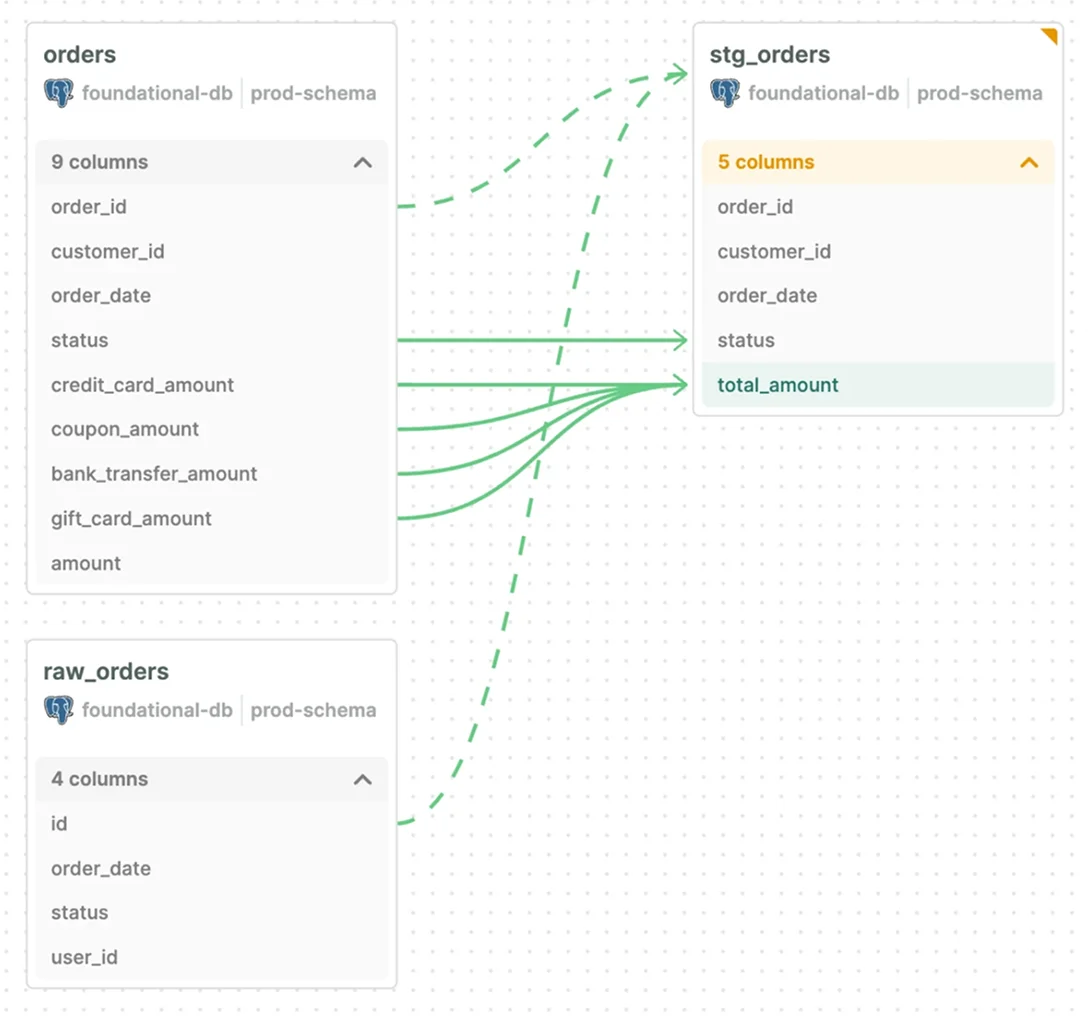
Because the lineage comes from code, it includes tables and columns that haven't run yet. In the total_amount example, Foundational follows credit_card_amount from the Java service into ORDERS, through m_load_fct_orders and on to the Tableau dashboard, so the team sees why revenue dropped and which other reports read the same column. It traces all of this without accessing your data.
Foundational also pushes its column-level data lineage into Informatica Cloud Data Governance and Catalog, Atlan, Collibra and DataHub, so your team sees the code-level view in the catalog it already uses. For a migration, it maps every dependency in your current setup and flags the Informatica mappings nobody uses anymore, so you can leave those behind instead of migrating them.
Fits when Informatica is one part of a stack that also runs application code, dbt or Spark, and you want one column-level view across all of it.
Collibra creates technical lineage for Informatica Intelligent Cloud Services (Cloud Data Integration) through an Edge connection, and for PowerCenter 9.6 and newer from files you prepare with the data objects to process. Both cover commonly used transformations, including SQL overrides. Collibra also harvests technical lineage from JDBC sources, other ETL tools and BI tools such as Tableau and Power BI, and you can add custom technical lineage for sources it doesn't list.
Fits when Collibra is your governance platform and you want Informatica lineage in the same catalog and stewardship workflows.
Atlan builds PowerCenter lineage by parsing repository XML exports that you upload or stage in cloud storage. It resolves field-to-field mappings, including columns derived through SQL overrides, and you refresh it by exporting again and rerunning the workflow. Its Informatica Cloud Data Integration connector covers mapping tasks and is available as a paid add-on. That lineage then sits alongside the other tools in your Atlan catalog, where warehouse lineage can come from mined query history.
Fits when Atlan is already your catalog and you can schedule regular PowerCenter exports.
IBM acquired Manta in 2023 to add data lineage to its data and AI governance products. IBM Data Lineage (formerly Manta) scans PowerCenter workflows, mappings, sessions and SQL overrides, and extracts them from the repository with Informatica's own command line tools. IBM also lists scanners for other integration tools such as DataStage, SSIS and Talend, and BI tools such as Power BI, Tableau and Cognos.
Fits when your stack runs several legacy ETL tools and you want one lineage scanner across them within IBM's governance products.
DataHub's Informatica connector, currently in beta, ingests Informatica Cloud (IDMC) projects, mapping tasks and taskflows. It resolves table-level lineage from each mapping's sources and targets and links it to datasets from other connectors, such as Snowflake, Oracle and BigQuery.
Fits when you run DataHub as your open-source catalog and table-level lineage through Informatica Cloud covers what you need.
Start with what you plan to do with Informatica, then check which tool covers the systems around it.
Bring one Informatica mapping and we'll trace it from the code that feeds it to the dashboards that read it.
Bring one Informatica mapping and we'll trace it from the code that feeds it to the dashboards that read it.
Bring one Informatica mapping and we'll trace it from the code that feeds it to the dashboards that read it.