Table of Content

Subscribe to our Newsletter
Get the latest from our team delivered to your inbox
Thank you! Your submission has been received!
Oops! Something went wrong while submitting the form.
Ready to get started?
Try It Free

Data impact analysis shows which tables, pipelines and dashboards a code or schema change will affect, so you can catch the break before merge. Foundational, Atlan, Monte Carlo, DataHub and Datafold each handle it differently.
Say a backend engineer renames plan_tier to subscription_tier in a SQLAlchemy model in the accounts service. The pull request touches only Python, so nobody on the data team is asked to review it. After the deploy, the new column name flows into Postgres, the nightly replication copies it into Snowflake, and the dbt model that still reads plan_tier fails. The revenue-by-plan dashboard in Looker goes blank the next morning.
The rename crossed four kinds of systems before anyone noticed:
A useful impact analysis tool sees all four while the change is still a pull request. If it only knows the warehouse and BI side, the first sign of the break is the blank dashboard.
All five tools below can tell you what sits downstream of a change. They differ in where that lineage comes from and when you see the answer.
| Tool | How it finds the impact | When you see it | What it reaches |
|---|---|---|---|
| Foundational | Diffs a column-level data flow graph built from code | On the pull request, before merge | Application code, pipelines, warehouses and BI |
| Atlan | Looks up downstream assets in the Atlan catalog | On dbt pull requests, through a GitHub Action | Assets already in your Atlan catalog |
| Monte Carlo | Traces Monte Carlo lineage, alerts and monitor coverage | On the pull request, with a risk tier | Tables and BI reports in Monte Carlo lineage |
| DataHub | Queries the DataHub lineage graph | On demand in the UI, or scripted through GraphQL | Entities with lineage ingested into DataHub |
| Datafold | Compares staging data with production data | In Datafold Classic, on the pull request after a staging build | Value-level data changes, BI impact in the app |
Foundational is a data & AI governance platform that statically analyzes your code to build a column-level data flow graph. It reads Python, Java, TypeScript, Go, Scala, SQL, dbt, Spark and more, and connects that to the metadata in your warehouses and BI tools. On every pull request it compares today's data flow graph with the one after the change, then names each consumer that would break or be affected, for changes such as a removed or renamed column that's still in use, or a column type change.
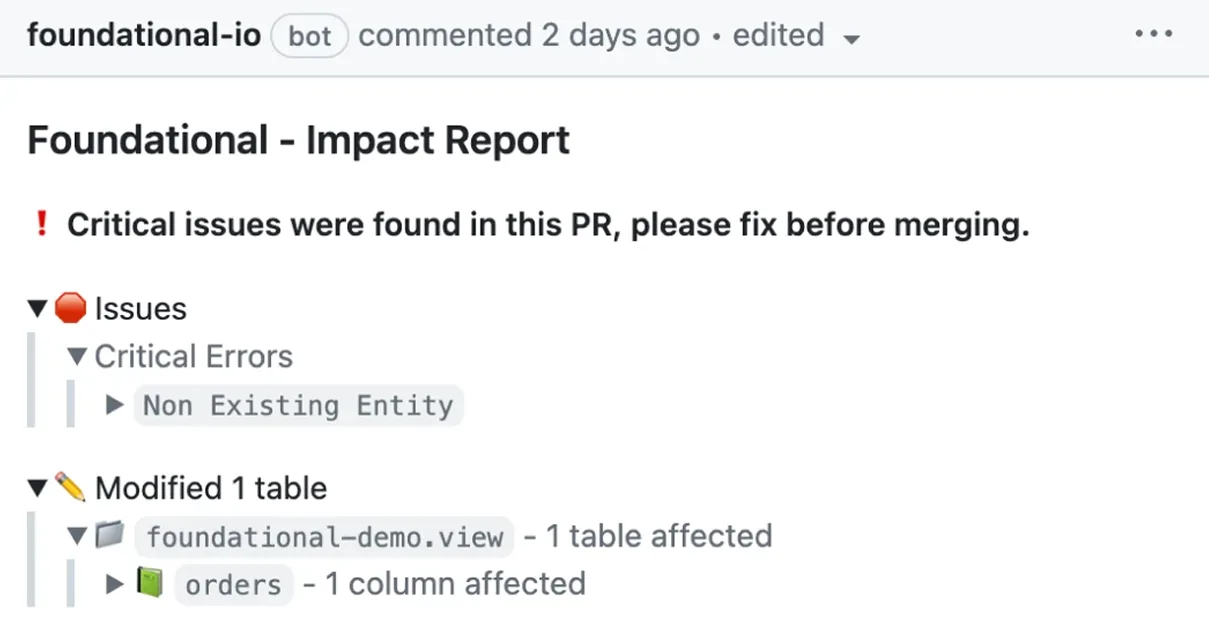
For application code, it reads ORM models such as SQLAlchemy and extracts the database schema from the object definitions, so the plan_tier rename shows up with the dbt models and Looker dashboards it reaches. The impact report appears as a comment on the pull request in your source control, such as GitHub, GitLab or Bitbucket. Foundational doesn't access your data.
Fits when schema changes start in application code or cross several tools, and you want to catch them before merge.
Atlan's GitHub Action puts its impact analysis on pull requests that change dbt models, so you can see the potential downstream impact before merging. The action reads the lineage already in your Atlan instance, using an API token with permissions on dbt, the warehouse layer and downstream connections such as Power BI. When the pull request merges, Atlan links it as a resource on the affected assets.
Fits when Atlan is already your catalog and most changes happen in dbt models.
Monte Carlo's PR review is part of MC Prevent. It reads the pull request diff for column-level changes and traces Monte Carlo lineage to the tables, BI reports and other consumers affected. Each affected asset gets a Low, Medium or High risk tier based on breaking changes, active alerts, blast radius and monitor coverage, and the pull request gets an overall risk score. A CI merge gate can block risky pull requests. The free review gives a risk score and summary, and the full review with suggested fixes is a paid feature.
Fits when your team already uses Monte Carlo for data observability and wants its alerts and lineage in code review.
DataHub's Lineage Impact Analysis, available in DataHub Core and DataHub Cloud, lists every upstream and downstream dependency of a dataset, dashboard, chart or other entity. You can filter by degree of dependency, entity type, platform and owner, export the list to CSV, or query it through the GraphQL API for automated checks. It works for any entity that already has lineage ingested into DataHub.
Fits when you run DataHub as your catalog and want impact lists for planning a change, or a scripted check you build yourself.
In CI, Datafold builds staging data from your branch, compares it with production and writes a Data Diff summary on the pull request, with downstream BI impact available in the Datafold app. It can add AI code reviews of SQL and pipeline code. Per Datafold's docs, CI testing is available in Datafold Classic and not in the current version, which focuses on data migrations.
Fits when you want to see how the values themselves change on a dbt or SQL pull request and you already use Datafold Classic.
Start with where your breaking changes come from, then check which tool can see that place.
If most of your changes are dbt models, this walkthrough of dbt pull requests shows how dbt CI and BI lineage fit together.
Bring a recent change and we'll walk through its downstream impact, from application code to dashboards.
Bring a recent change and we'll walk through its downstream impact, from application code to dashboards.
Bring a recent change and we'll walk through its downstream impact, from application code to dashboards.