Table of Content

Subscribe to our Newsletter
Get the latest from our team delivered to your inbox
Thank you! Your submission has been received!
Oops! Something went wrong while submitting the form.
Ready to get started?
Try It Free


IBM Manta Data Lineage builds column-level lineage by scanning databases, ETL tools, BI tools and code. Alternatives like Foundational, Informatica, Collibra and Solidatus differ in what each tool reads, how it refreshes, and what happens when a system has no scanner.
A COBOL batch job on a mainframe writes account_balance to Db2. A Java service reads it, an ETL job loads it into Snowflake, and a Power BI report shows it to the risk and finance teams. When the Java service changes how it rounds the balance, nobody can say which reports will move.
Scanner-based lineage may already trace part of this chain. Before you switch, list what your scans cover and which systems someone added by hand. A replacement has to trace four kinds of systems:
Each tool below documents a way to cover a system it has no scanner or connector for, through a framework, an SDK, custom lineage or manual links that your team adds. For the general shortlist, see our comparison of the best data lineage tools.
All five tools build column-level lineage, but they collect it in different ways.
| Tool | How it captures lineage | Coverage across your stack | Where it stops |
|---|---|---|---|
| Foundational | Static code analysis, plus warehouse and BI metadata | Mainframe and application code, pipelines, warehouses and BI | A repository or system has to be connected |
| IBM Manta Data Lineage | Scanners for code, databases, ETL and BI tools | COBOL, Java, C#, databases, ETL tools and BI tools | Systems without a scanner need the OpenManta framework |
| Informatica | Scans ETL, BI and database metadata | Informatica ETL, BI tools, databases and stored procedures | Scanned references need a connection assignment to resolve |
| Collibra | Parses SQL from supported sources, plus OpenLineage | JDBC sources, ETL tools and BI tools it supports | Dynamic queries and JSON or struct access aren't supported |
| Solidatus | Native connectors, SDK connectors, JDBC and OpenLineage | Cloud, database, ETL, BI and mainframe systems it connects | Other systems use its SDK, JDBC or OpenLineage |
Foundational is a data & AI governance platform. It statically analyzes code to build the data flow graph at the column level. It covers COBOL with JCL, copybooks and Db2, plus application code in Go, Java, Scala, Python and TypeScript, in the same data flow graph as Spark, Airflow, Informatica, Snowflake, Databricks, Looker, Tableau and Power BI.
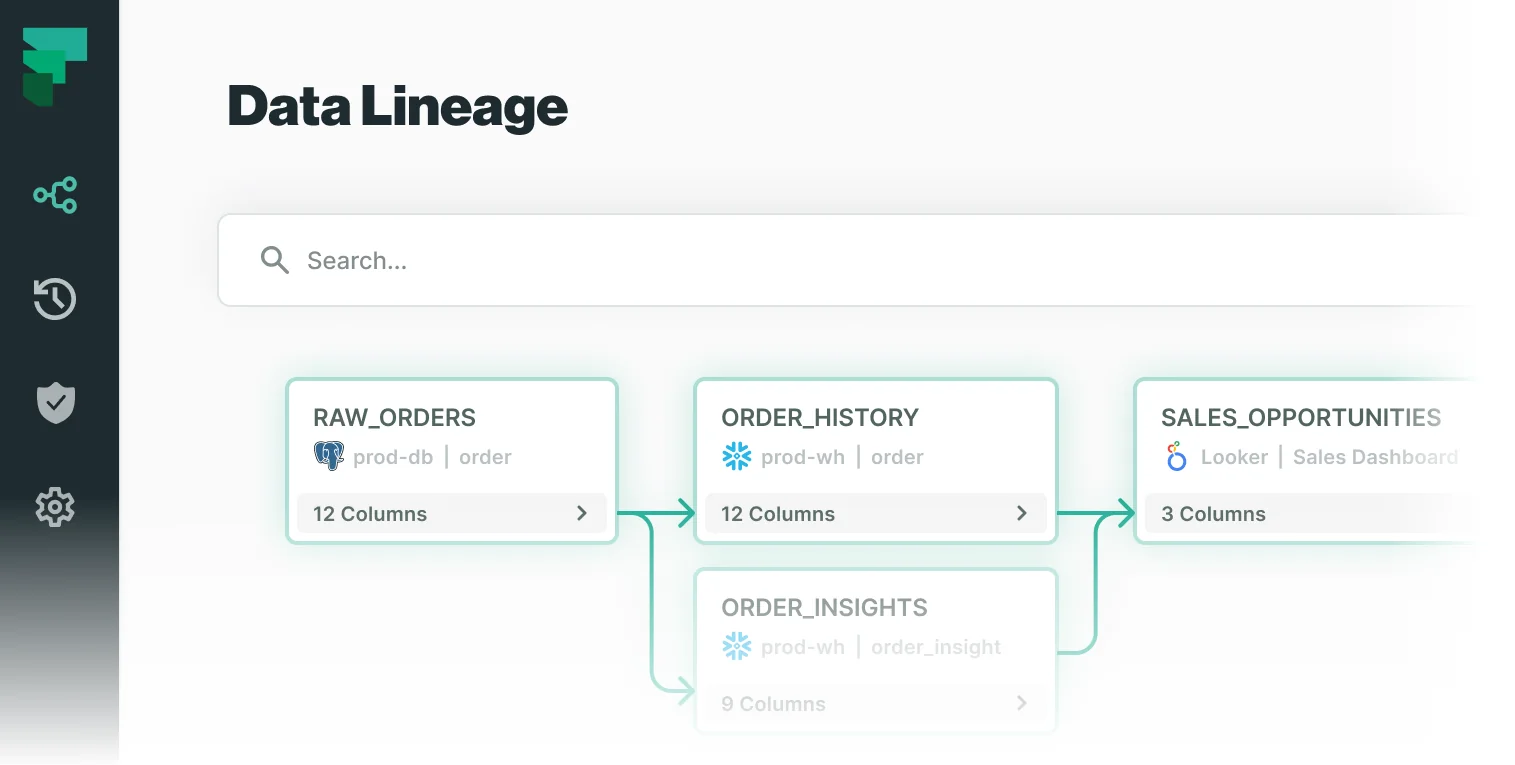
Because the lineage comes from code, it includes tables and columns that haven't run yet. In the account_balance example, Foundational follows the field from the COBOL job through the Java service and the ETL load to the Power BI report. It traces all of this without accessing your data. For the mainframe layer, see how mainframe lineage tools compare.
Foundational also runs impact analysis on the pull request. It lists the tables, dbt models, dashboards and owners a change would affect as a check and a comment in GitHub, GitLab, Bitbucket or Azure DevOps.

Foundational IQ adds agents grounded in the same data flow graph. They answer governance questions, create reports and open pull requests for tasks such as data quality and code checks. The platform also covers ontology and catalog on the data flow graph. It can push its column-level lineage into Informatica CDGC, Atlan, Collibra and DataHub, so replacing IBM Manta doesn't mean replacing your catalog.
Fits when you want column-level lineage across mainframe and application code, pipelines and BI, impact checks before code ships, and one platform for lineage, ontology and catalog.
IBM Manta Data Lineage is IBM's automated lineage product. IBM's product page calls it Data Lineage and places it under watsonx.data intelligence. Its docs call it IBM Automatic Data Lineage. Its scanners extract metadata from databases, ETL tools, BI tools and code. Administrators group them into workflows and choose how often to run scans. Each scan creates a revision. IBM says the analysis reads metadata such as code and schema definitions, and generally doesn't need direct access to data.
Its Java scanner analyzes compiled code such as class files and JARs. Its C# scanner reads assemblies and source files, and a COBOL scanner covers COBOL, Db2 and JCL. For custom-built systems with no scanner, IBM points to the OpenManta framework and APIs. IBM also lists CI/CD pipeline integration. Exports to catalogs such as Alation and Collibra use specialized licensed exports.
Fits when your company already uses IBM for lineage and wants COBOL, Java, ETL and BI tools in the same scans.
Informatica Cloud Data Governance and Catalog builds technical lineage from scanned metadata. Its ETL scanners cover Cloud Data Integration, PowerCenter and relational databases. Its BI scanners cover Tableau, Power BI and MicroStrategy, and its script scanners cover stored procedures. Scans first create reference objects, and you assign connections to resolve them into real assets. Informatica documents a connection-aware scan for dynamic SQL.
When source limits leave lineage incomplete, you can link catalog sources by rules or CLAIRE recommendations. Informatica's mainframe scanner reads JCL with the SQL scripts and copybooks it references, for assets already ingested into the catalog.
Fits when you already use Informatica's catalog and want technical lineage from its scanners.
Collibra Data Lineage automatically extracts lineage from the sources, ETL tools and BI tools it supports. It also supports the OpenLineage standard. Technical lineage is available at table and column level for those supported inputs, including JDBC data sources. You can add custom technical lineage for sources it doesn't list. Its SQL parser doesn't support DML on JSON or structs, or triggers, cursors and dynamic queries. Collibra says that list isn't exhaustive.
Fits when you already use Collibra for stewardship and want technical lineage from the sources it supports.
Solidatus ingests metadata through connectors for Snowflake, Databricks, Azure, AWS, Oracle, SQL Server, Informatica, dbt and mainframes. For other systems it offers an SDK for custom connectors, a bring-your-own JDBC path and OpenLineage ingestion. It parses to column level, including stored procedures. You can edit lineage models in a visual editor. Its impact analysis runs across downstream reports, models and dashboards.
Fits when you want visual lineage models, and your team can add custom connectors.
Start with the question you need answered, then check which tool can answer it.
account_balance pass through mainframe or application code?Bring one column from your stack and we'll trace it from the code that writes it to the report that shows it.
Bring one column from your stack and we'll trace it from the code that writes it to the report that shows it.
Bring one column from your stack and we'll trace it from the code that writes it to the report that shows it.