Blog
Articles
Mainframe data lineage tools compared (2026): Foundational, IBM Manta, Informatica, Solidatus, Rocket

Mainframe data lineage tools compared (2026): Foundational, IBM Manta, Informatica, Solidatus, Rocket

Articles
November 24, 2026
Team Foundational
Subscribe to our Newsletter
Get the latest from our team delivered to your inbox
Thank you! Your submission has been received!
Oops! Something went wrong while submitting the form.
Ready to get started?
Try It Free
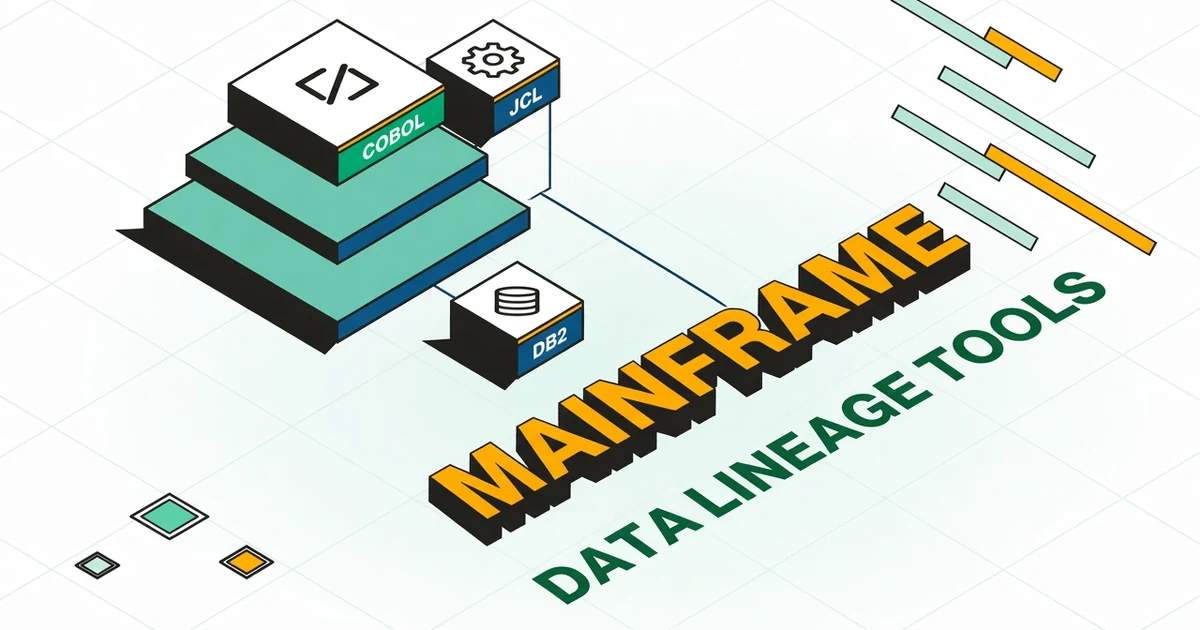
Isometric illustration of stacked layers topped by a COBOL code block linked to JCL and DB2 blocks, with the lettering MAINFRAME, data lineage tools.

Mainframe data lineage shows what feeds each COBOL field and what reads it downstream, so a change or migration doesn't break reports. Foundational, IBM Manta, Informatica, Solidatus and Rocket each trace it differently.

Why mainframe lineage has to come from the code

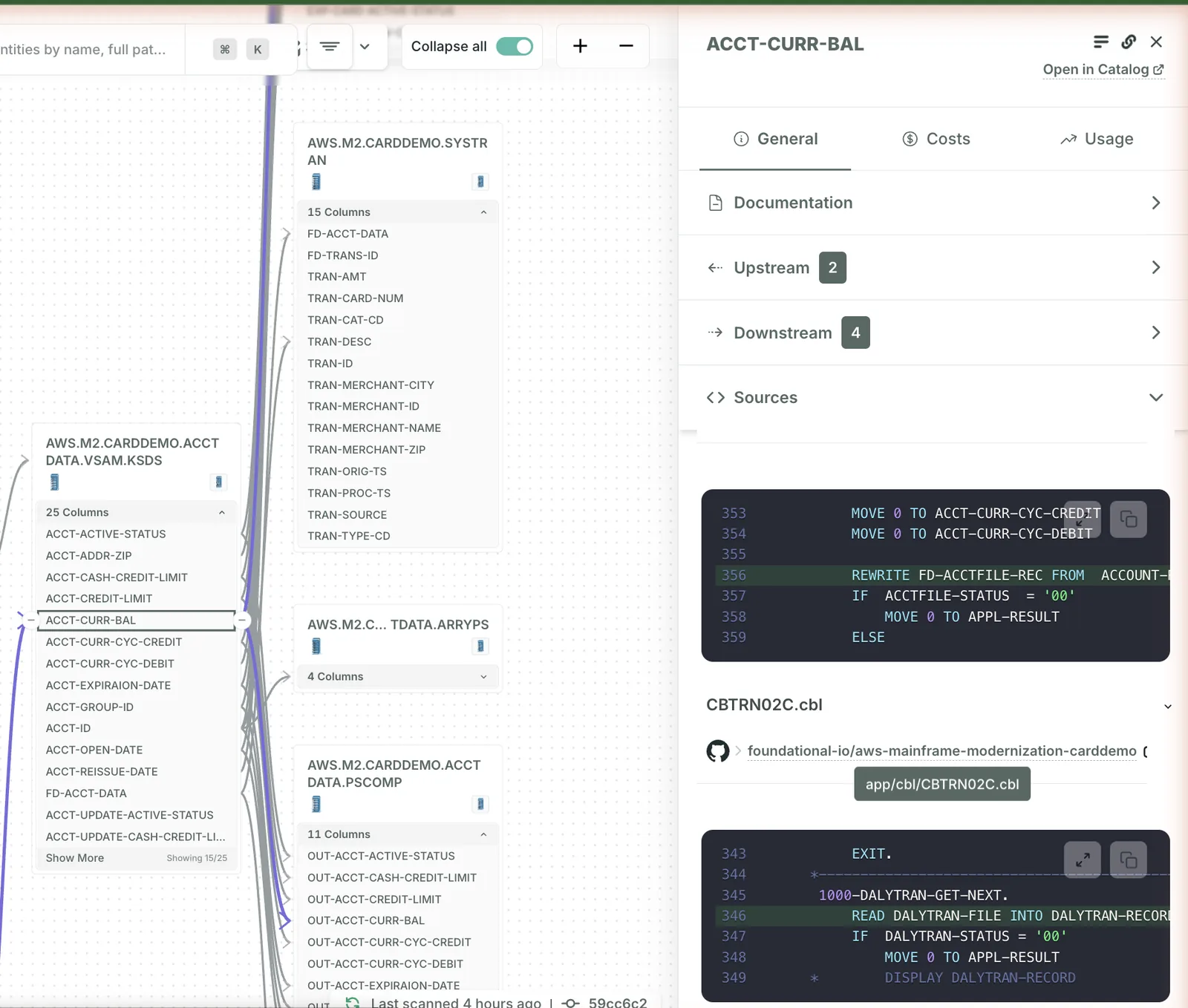
Take ACCT-CURR-BAL, the current balance in the account master of AWS CardDemo, a public sample mainframe application. Each night the POSTTRAN job runs the COBOL program CBTRN02C, which reads the day's transactions from a flat file and adds each amount to the balance. Say a Java service then copies the account master into Snowflake and a credit-risk dashboard reads the balance from there. If a rewrite changes how CBTRN02C posts that amount, the dashboard shows the wrong number the next morning.

The posting job doesn't run a single SQL query, so tools that rebuild lineage from query logs have nothing to read. The logic that moves ACCT-CURR-BAL sits in mainframe source code:

  • COBOL programs
    Reads, writes and arithmetic decide which input fields end up in the balance.
  • Copybooks
    Shared record layouts define each field, and REDEFINES clauses can overlay two layouts on the same bytes.
  • JCL
    DD statements bind each program's logical files to the physical datasets a job step reads and writes.
  • Db2
    Embedded SQL (EXEC SQL) ties program fields to the Db2 tables they read and write.

A lineage tool has to read all four, then follow the field off the mainframe, before it can tell you what a change will affect.

Mainframe data lineage tools compared

All five tools below analyze mainframe code. They differ in what they connect it to and where the lineage ends.

Tool How it builds lineage Mainframe coverage Reach beyond the mainframe
Foundational Static analysis of mainframe and application source code COBOL, copybooks, JCL, Db2 and BMC Java and other application code, pipelines, warehouses and BI
IBM Manta Data Lineage IBM scanners for COBOL, JCL and Db2 COBOL, JCL, Db2 and other system components Other applications that source data from COBOL systems
Informatica CDGC IBM Mainframe scanner feeding the Informatica catalog JCL jobs and steps, programs, copybooks Only assets already ingested into the catalog
Solidatus Mainframe scanning into visual lineage models COBOL, JCL, PL/1, CICS, IMS, Natural and more Complete regulatory data flows across your systems
Rocket Enterprise Analyzer Static code analysis in a central application repository COBOL dialects, PL/I, JCL, Assembler, Natural, Java Code, data and interfaces inside the analyzed portfolio

How each mainframe lineage tool works

Foundational

Foundational is a data & AI governance platform that statically analyzes your COBOL programs, copybooks, JCL and Db2 code to build a field-level data flow graph. It expands copybooks before analysis, including REDEFINES overlays, binds JCL DD statements to real datasets, and keeps data flow apart from control flow, so a field that only appears in a condition doesn't show up as a source. The same analysis covers Python, Java, TypeScript, Go, Scala, SQL and more, along with pipelines, warehouses and BI tools, so ACCT-CURR-BAL traces from CBTRN02C to the dashboard that shows it.

Foundational data flow graph on AWS CardDemo with ACCT-CURR-BAL selected in the account master, and the COBOL lines from CBTRN02C.cbl that update it.
Foundational on AWS CardDemo: ACCT-CURR-BAL in the data flow graph, with the COBOL lines in CBTRN02C behind it.

Foundational works from read-only access to your source code and doesn't connect to the mainframe or production Db2. If your team reviews COBOL changes in pull requests, Foundational flags the downstream impact there before the change merges.

Fits when you need field-level lineage from mainframe code into Java, cloud platforms and BI, with impact checks before changes ship.

IBM Manta Data Lineage

IBM Manta Data Lineage, also documented as IBM Automatic Data Lineage, extracts lineage from COBOL source code, Db2 and JCL, and shows it in interactive diagrams with impact and root cause queries. IBM positions it for COBOL modernization and says the lineage extends to applications that source data from COBOL systems. Its JCL scanner links jobs and datasets to the COBOL or SAS programs they call, and IBM's docs note that JCL utility steps such as SORT produce no lineage.

Fits when your company already runs IBM for data governance and wants mainframe lineage in the same place.

Informatica Cloud Data Governance and Catalog

Informatica's IBM Mainframe scanner reads JCL jobs, plus the SQL scripts and copybooks they reference, and creates programs, copybooks, JCL steps and jobs as assets in Cloud Data Governance and Catalog (CDGC). Lineage from JCL applies only to assets already ingested into the catalog, such as Db2 for z/OS tables, so those endpoints have to be scanned first.

Fits when CDGC is already your enterprise catalog and you want mainframe jobs inside it.

Solidatus

Solidatus scans mainframe code to identify data flows and shows them as visual lineage alongside the rest of your systems. Its factsheet lists COBOL, JCL, PL/1, CICS, IMS, IDMS, Natural, Easytrieve and other mainframe technologies, and positions the lineage for regulatory data flows and migration planning. Subject matter experts can record and share what they know in the same models.

Fits when regulatory lineage is the main goal and your experts want to build and annotate the models together.

Rocket Enterprise Analyzer

Rocket Enterprise Analyzer, formerly a Micro Focus product, is a static code analysis platform for understanding large mainframe application portfolios. It supports several COBOL dialects, PL/I, JCL, Assembler, Natural and Java, and traces program and data flow within and across modules to show the impact of a change. It also includes business rule mining and a natural language assistant for exploring the code.

Fits when your developers need to understand and document COBOL logic before a rewrite, more than they need lineage into cloud and BI.

How to choose a mainframe data lineage tool

Start with the question you need answered, then check which tool can answer it.

  • Does lineage need to reach past the mainframe?
    If a field like ACCT-CURR-BAL feeds Java services, Snowflake or dashboards, check that the tool links mainframe fields to that code and those systems, not only to datasets.
  • Field level or job level?
    Ask whether lineage resolves copybooks and REDEFINES down to each field, or stops at jobs and datasets.
  • Do you need answers before code merges?
    A tool that reads code and checks pull requests shows a change's impact while it's still in review.
  • What access does it need?
    Some tools work from source code alone. Others need the endpoints scanned into a catalog first.
  • Is this for a migration?
    A lineage tool shows what depends on the data. To assess and convert the code itself, pair it with one of the mainframe modernization tools built for that.

Frequently asked questions

Which is the best data lineage tool for mainframe JCL, Db2 and copybooks?

If you need field-level lineage that continues past the mainframe, Foundational statically analyzes COBOL, copybooks, JCL and Db2 together and links them to Java, warehouses and BI. IBM Manta covers COBOL, JCL and Db2 with IBM's scanners.

Informatica scans JCL and copybooks into its catalog, Solidatus maps mainframe flows for regulatory lineage, and Rocket Enterprise Analyzer documents application logic. Check copybook expansion, JCL DD binding and Db2 coverage in each vendor's current docs.

How do you get column-level lineage for COBOL?

Use a tool that parses the COBOL source together with its copybooks. Field-level lineage needs copybooks expanded, including REDEFINES overlays, and every read, write and calculation traced to the field it changes.

Foundational does this and records the line of code behind each step, so ACCT-CURR-BAL shows the ADD statement in CBTRN02C that updates it. It also uses the JCL to bind each logical file to the real dataset.

What are the alternatives to IBM Manta for mainframe data lineage?

Foundational, Informatica CDGC, Solidatus and Rocket Enterprise Analyzer all analyze mainframe code. Foundational is the closest fit if you want lineage built from static code analysis that also covers Java and other application code, pipelines, warehouses and BI.

Informatica makes sense if you already use its catalog, and Solidatus fits regulatory lineage programs. Rocket Enterprise Analyzer suits developers who need to understand and document COBOL code.

How do you trace data from COBOL programs and copybooks into a cloud data warehouse?

Trace each field through the mainframe first, then follow it into the code that moves it off. That usually means a Java or Python job, a pipeline, and the warehouse models and dashboards that read the result.

Foundational builds one data flow graph across all of that. It matches the same table and column names across COBOL and Java JDBC code, then continues through Snowflake, Databricks or BigQuery to the BI layer.

How do you document COBOL data flows and business logic before a rewrite?

Start from the source that actually runs: COBOL programs, copybooks, JCL and Db2 definitions. Then trace each critical field from where it starts to every program that changes it and every system that reads it.

Code analysis tools such as Rocket Enterprise Analyzer document program logic for developers. Foundational adds the data flow graph across the mainframe and the systems downstream, and keeps it up to date as the code changes.

How does data lineage help a mainframe migration to the cloud?

Lineage shows which programs, jobs, files and tables depend on each field, including the services, pipelines and dashboards off the mainframe. You can then plan the move by dependency and repoint consumers before cutover.

Foundational builds that view from read-only access to your source code, with no connection to the mainframe or production Db2. If your team reviews COBOL changes in pull requests, Foundational can then check each migration code change for downstream impact before it merges.

code snippet <goes here>
<style>.horizontal-trigger {height: calc(100% - 100vh);}</style>
<script src="https://cdnjs.cloudflare.com/ajax/libs/gsap/3.8.0/gsap.min.js"></script>
<script src="https://cdnjs.cloudflare.com/ajax/libs/gsap/3.8.0/ScrollTrigger.min.js"></script>
<script>
// © Code by T.RICKS, https://www.timothyricks.com/
// Copyright 2021, T.RICKS, All rights reserved.
// You have the license to use this code in your projects but not to redistribute it to others
gsap.registerPlugin(ScrollTrigger);
let horizontalItem = $(".horizontal-item");
let horizontalSection = $(".horizontal-section");
let moveDistance;
function calculateScroll() {
 // Desktop
 let itemsInView = 3;
 let scrollSpeed = 1.2;  if (window.matchMedia("(max-width: 479px)").matches) {
   // Mobile Portrait
   itemsInView = 1;
   scrollSpeed = 1.2;
 } else if (window.matchMedia("(max-width: 767px)").matches) {
   // Mobile Landscape
   itemsInView = 1;
   scrollSpeed = 1.2;
 } else if (window.matchMedia("(max-width: 991px)").matches) {
   // Tablet
   itemsInView = 2;
   scrollSpeed = 1.2;
 }
 let moveAmount = horizontalItem.length - itemsInView;
 let minHeight =
   scrollSpeed * horizontalItem.outerWidth() * horizontalItem.length;
 if (moveAmount <= 0) {
   moveAmount = 0;
   minHeight = 0;
   // horizontalSection.css('height', '100vh');
 } else {
   horizontalSection.css("height", "200vh");
 }
 moveDistance = horizontalItem.outerWidth() * moveAmount;
 horizontalSection.css("min-height", minHeight + "px");
}
calculateScroll();
window.onresize = function () {
 calculateScroll();
};let tl = gsap.timeline({
 scrollTrigger: {
   trigger: ".horizontal-trigger",
   // trigger element - viewport
   start: "top top",
   end: "bottom top",
   invalidateOnRefresh: true,
   scrub: 1
 }
});
tl.to(".horizontal-section .list", {
 x: () => -moveDistance,
 duration: 1
});
</script>

See lineage on your own COBOL

Send us COBOL, copybooks and JCL, and we'll walk you through field-level lineage on your own code.

See lineage on your own COBOL

Send us COBOL, copybooks and JCL, and we'll walk you through field-level lineage on your own code.

See lineage on your own COBOL

Send us COBOL, copybooks and JCL, and we'll walk you through field-level lineage on your own code.

Share this post
Subscribe to our Newsletter
Get the latest from our team delivered to your inbox
Thank you! Your submission has been received!
Oops! Something went wrong while submitting the form.
Ready to get started?
Try It Free

Governance that starts at the source.