Table of Content

Subscribe to our Newsletter
Get the latest from our team delivered to your inbox
Thank you! Your submission has been received!
Oops! Something went wrong while submitting the form.
Ready to get started?
Try It Free

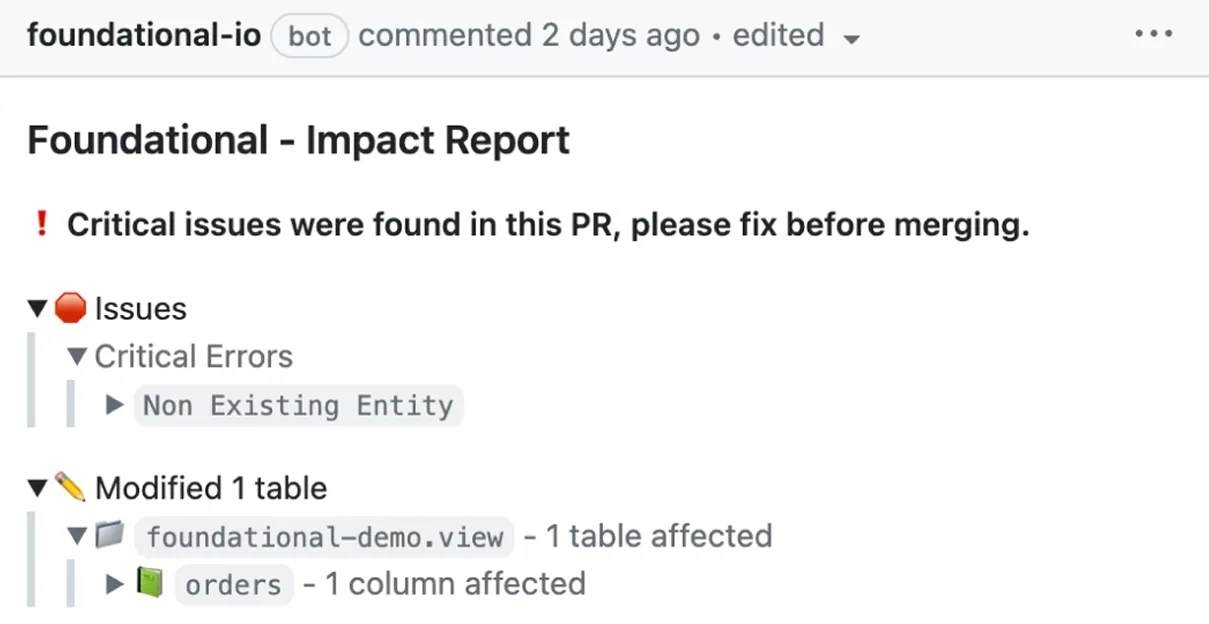
Before you change a Java service, you want to know which tables and dashboards depend on its data before the change merges. Foundational reads Java source and checks pull requests, IBM Manta scans compiled builds, and OpenLineage, DataHub and Spline record lineage as jobs run.
Take totalAmount on the Order entity. Hibernate maps it to orders.total_amount, a JDBC job sums it into reporting.order_summary, and a revenue dashboard reads that table. If you change that mapping in the entity, the build still passes, but the dashboard breaks on its next refresh.
Warehouse query logs only see the final read and the final write. The steps that decide where total_amount ends up sit in Java application code:
@Column and @JoinColumn decide which table and column a field lands in.A lineage tool can reach that logic by reading the code or by watching it run. Two of the tools below read Java code before it runs, and the other three record lineage while jobs run.
| Tool | How it builds lineage | Java coverage | Fits when |
|---|---|---|---|
| Foundational | Reads Java source in your repositories | Hibernate, Spring Data JPA, MyBatis, JDBC, jOOQ and more | You need lineage and impact checks before code ships |
| IBM Manta Data Lineage | Static analysis of compiled Java bytecode | JDBC, Spring JdbcTemplate, MyBatis, Hibernate, Spark | You already use IBM for enterprise lineage |
| OpenLineage (with Marquez) | Events emitted by jobs at runtime | Spark listener, Java client for custom events | You want an open standard for runtime lineage |
| DataHub | Runtime Spark agent plus pushed metadata | Spark agent, Java SDK emitter | You want an open-source catalog with lineage |
| Spline | Runtime agent on Spark jobs | Spark jobs in Scala, Python or Spark SQL | Your lineage need is mostly Spark |
Foundational is a data & AI governance platform that statically analyzes your Java code to build a column-level data flow graph, with no running database and no changes to your application. It follows total_amount from the Hibernate entity through the JDBC job to the dashboard, and flags that mapping change in the pull request before it merges. The same analysis covers Python, Scala, SQL, TypeScript, Go, COBOL and more, along with dbt, Spark, warehouses and BI tools, so the Java service stays connected to everything downstream.
Fits when you need lineage and impact checks before code ships, across application code, pipelines and dashboards.
IBM Manta's Java scanner runs static data-flow analysis on compiled Java, including class files, JAR libraries and Spring Boot JAR or WAR files. Plugins handle JDBC, Spring JdbcTemplate, MyBatis, Hibernate and Spark, and the Java results join lineage from more than 40 scanners for databases, ETL and reporting tools. The scanner reads bytecode, so teams don't have to hand over source code.
Fits when your company already uses IBM for lineage and wants Java in the same scans.
OpenLineage is an open standard for lineage events, and Marquez is its reference backend. The Spark integration listens to jobs as they run and reads their dataset dependencies, and the Java client lets you emit events from your own code. Lineage shows up after a job runs, so a change still in review isn't covered yet.
Fits when you want a vendor-neutral format and can instrument the jobs you care about.
DataHub is an open-source metadata platform with a catalog and lineage. For Java, it offers a Spark agent built on OpenLineage that captures column-level lineage by default. It also has a Java emitter for pushing metadata from JVM systems such as CI pipelines or custom orchestrators, and lineage for a plain Java service comes from the metadata that service pushes.
Fits when you want an open-source catalog and are ready to run its agents and emitters.
Spline started as a Spark lineage tool, and Spark is still its main focus. Its agent attaches to jobs written in Scala, Python or Spark SQL, records lineage from each run and sends it to the Spline server and UI. By default it tracks persistent writes, such as files, Hive tables and databases.
Fits when your lineage need is mostly Spark and you want a free, focused tool.
Start with the question you need answered, then check which approach can answer it.
We'll walk through lineage from your services to the dashboards they feed.
We'll walk through lineage from your services to the dashboards they feed.
We'll walk through lineage from your services to the dashboards they feed.