Blog
Articles
Context layer tools for AI agents compared (2026): Foundational, Atlan, DataHub, Alation, dbt

Context layer tools for AI agents compared (2026): Foundational, Atlan, DataHub, Alation, dbt

Articles
November 24, 2026
Team Foundational
Subscribe to our Newsletter
Get the latest from our team delivered to your inbox
Thank you! Your submission has been received!
Oops! Something went wrong while submitting the form.
Ready to get started?
Try It Free
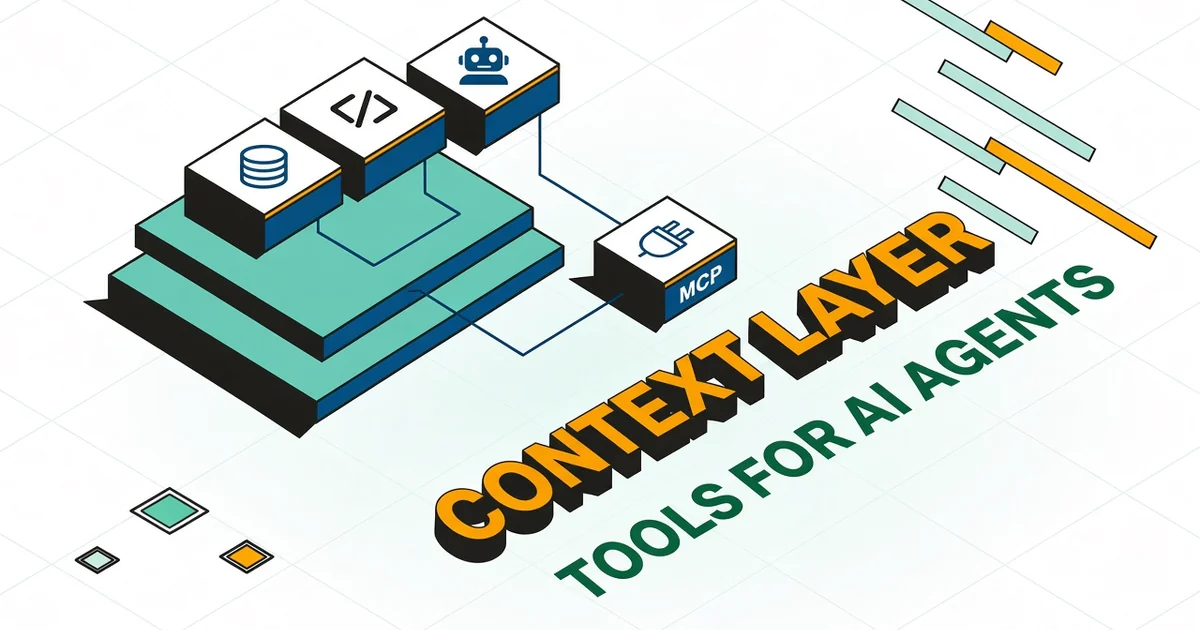
Isometric illustration of stacked layers topped by database, code and AI agent blocks linked to an MCP block, with the lettering CONTEXT LAYER, tools for AI agents.

A context layer tells AI agents what your data means, where it comes from and whether it's current, so they stop answering from the wrong tables. Foundational, Atlan, DataHub, Alation and dbt build it differently.

Why AI agents give wrong answers about your data

Say an analytics agent in Snowflake Cortex is asked for last quarter's net revenue. The warehouse has net_revenue in fct_orders. It also has an older revenue_net column in orders_legacy, which an unowned Python job still refreshes every night. Both columns have descriptions in the catalog, so the agent picks the one whose name fits the question. If it picks orders_legacy, the answer looks fine but it's wrong, and no log shows an error.

The model didn't reason badly. It was missing the context that tells the two columns apart:

  • What does this column mean?
    Which column holds the agreed definition of net revenue, and how it's calculated.
  • Can the agent trust it?
    Who owns each table, whether it's deprecated, and whether anything current still reads it.
  • Where did the value come from?
    Which jobs and services wrote it, back to the code that calculates it.
  • May this agent use it?
    Which data this agent and the person asking are allowed to see.

Catalogs and semantic layers help with the first two questions. They collect definitions, ownership and lineage from the warehouses, BI tools and pipelines they connect to. When the calculation behind net_revenue lives in application code, such as a Python billing service, the agent also needs context derived from that code.

Context layer tools compared

All five tools serve context to agents over MCP. They differ in where that context comes from and how far it reaches.

Tool How it builds context What agents get What the context covers
Foundational Static analysis of source code across repositories and languages Lineage, code definitions, owners and usage over MCP Application code, pipelines, warehouses, BI and AI calls
Atlan Metadata, lineage and policy from connected platforms Governed context repositories, deployed through Atlan MCP Assets in the warehouses, BI and dbt Atlan connects to
DataHub Metadata graph built from ingested sources Search, lineage, owners and quality signals over DataHub MCP Entities ingested into DataHub
Alation Catalog, context and agent layers Catalog context search and data quality over MCP Assets cataloged in Alation
dbt Semantic Layer Metrics defined in code with MetricFlow Governed metrics through the dbt MCP server Metrics built on dbt models

How each context layer tool works

Foundational

Foundational is a data & AI governance platform that statically analyzes your source code to build a column-level data flow graph. It covers Python, Java, TypeScript, Go, Scala, SQL, COBOL, dbt, Spark and more, along with pipelines, warehouses and BI tools. When an agent asks about net_revenue, it gets the code that defines the column, its owners, and the models and dashboards that use it.

Agents reach that context through the Foundational MCP server from Snowflake Cortex, Microsoft 365 Copilot, ChatGPT, Claude, Cursor, GitHub Copilot and other MCP clients. The server returns lineage and definitions, never table contents.

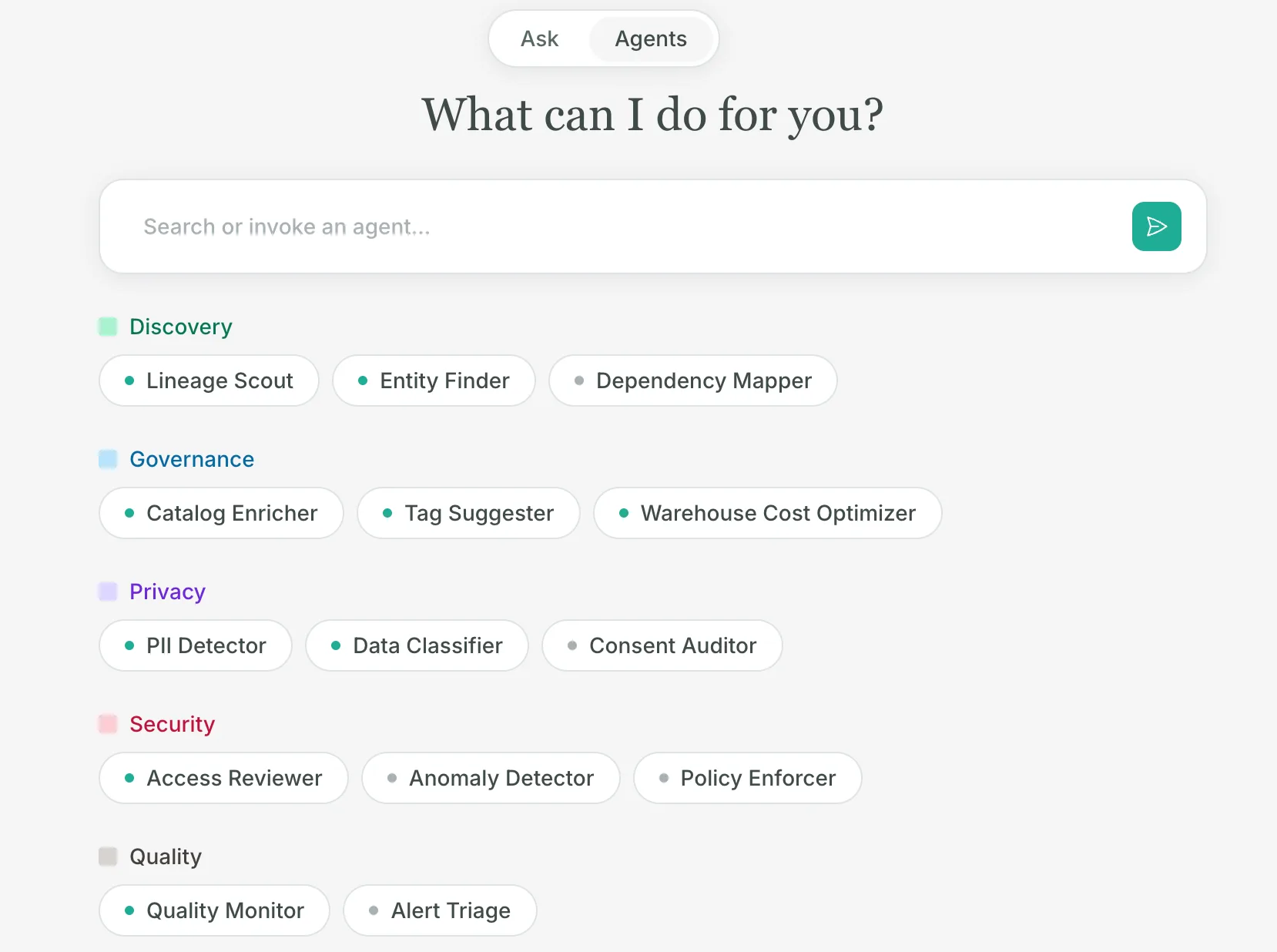
Foundational IQ agents view listing agents by category, including Lineage Scout, Entity Finder and Dependency Mapper under Discovery, and PII Detector and Data Classifier under Privacy.
Foundational IQ runs discovery, governance, privacy, security and quality agents on the same data flow graph.

The same data flow graph lets you govern the agents themselves. You can see which data each AI agent and LLM call reads, find agents that pull from stale or deprecated sources, and flag agents whose code doesn't follow your ontology.

Fits when your agents need the logic behind the data, across application code, pipelines, warehouses and BI, and you want to govern which data each agent uses.

Atlan

Atlan describes itself as the enterprise context layer for AI, built from metadata, lineage and policy. It reconstructs lineage through SQL parsing, API crawling and source metadata, then adds glossary terms, ownership and access policies scoped by domain.

Its Context Engineering Studio assembles a context repository for each domain and deploys it to Snowflake Cortex Analyst, Databricks Genie or any MCP client through the Atlan MCP server. When a linked asset changes upstream, the repository flags it for a redeploy.

Fits when Atlan is already your catalog and you want governed context for analytics agents, one domain at a time.

DataHub

DataHub calls itself a context platform built on its metadata graph. Its MCP server lets agents search assets, read ownership, documentation, glossary terms and quality signals, and trace table and column lineage. It runs as a managed server on DataHub Cloud or self-hosted with DataHub Core, the open source version.

Fits when you want an open source metadata platform that your agents can query directly.

Alation

Alation splits what agents need into three layers that it calls the Knowledge Layer. A catalog sits at the base, a context layer of data products, metrics and policies sits on top, and an agent layer adds evaluations and feedback. Its AI Agent SDK includes an MCP server that gives agents catalog context search, with tools for data quality.

Fits when Alation is your catalog and you want an agent layer that adds evaluations and feedback on top of it.

dbt Semantic Layer

The dbt Semantic Layer, powered by MetricFlow, defines metrics such as revenue once in your dbt project. AI tools like Claude and ChatGPT connect to it through the dbt MCP server, so their answers use governed metrics instead of guessing at raw tables. Its context covers the metrics you define on top of dbt models.

Fits when your agents mostly answer metric questions and your transformations already run in dbt.

How to choose a context layer for AI agents

Start with what your agents do, then check where each tool's context comes from.

  • Can you see which data each agent reads?
    Check that the tool maps each agent and LLM call to the tables and columns it uses, not only to datasets in a catalog.
  • Will it catch stale data?
    Ask how the tool tells an agent that a table is deprecated or no longer used, and how quickly that signal updates.
  • Does it follow your ontology?
    Your business terms should map to the columns that implement them, so every agent uses the same meaning.
  • Does the context come from the code?
    If business logic lives in application code, pipelines or mainframe programs, check whether the tool derives context from that code too.

Frequently asked questions

What is a context layer for enterprise AI, and which vendors provide one?

A context layer sits between your data and your AI agents. It gives them business definitions, ownership, quality and freshness signals, lineage and access rules, so they pick the right data and use it correctly.

Atlan, DataHub and Alation offer context layers built on their catalogs, with definitions, ownership and lineage. The dbt Semantic Layer covers metrics. Foundational adds context derived from the code that produces and uses the data, so agents get the logic behind each column and you see a change's impact before it merges.

What are the best tools to give enterprise AI agents trusted data context?

It depends on where your trusted definitions live. Atlan, DataHub and Alation serve catalog metadata, lineage and ownership to agents over MCP, and the dbt Semantic Layer serves governed metrics.

If business logic lives in application code and pipelines, Foundational adds context built from that code, including how each column is defined and what uses it. It also shows which data each agent reads, so you can confirm your agents use trusted sources.

How do you provide data context to LLMs for text-to-SQL and analytics agents?

Give the agent governed metric definitions, table and column descriptions, and signals that mark the right tables to use. A semantic layer such as dbt's covers the metrics.

Then add lineage and ownership over MCP, so the agent can check where a value comes from before it answers. Foundational's MCP server connects to Snowflake Cortex, Microsoft 365 Copilot, ChatGPT and other MCP clients.

Semantic layer vs context layer for enterprise AI: which tools should you evaluate?

A semantic layer defines each metric once, so every query computes it the same way. A context layer adds descriptions, ownership, quality signals and access rules around the rest of your data.

Evaluate the dbt Semantic Layer for metrics, and Atlan, DataHub or Alation for catalog-based context. If your agents need the logic inside your code, add Foundational. Our guide to the context layer vs semantic layer covers when each one matters.

How do you give AI coding agents context about your data pipelines and lineage?

Connect them to a lineage source over MCP, so they can ask what reads a table or column before they edit it. Then add a rule to CLAUDE.md or AGENTS.md that tells the agent when to ask.

Foundational's MCP server gives Claude Code, Cursor, Codex, GitHub Copilot and Devin end-to-end lineage across repositories and languages, with owners and code definitions. Our guide shows how to connect it to your coding agents.

What are enterprise context engineering platforms for AI agents?

Context engineering is choosing what an AI model sees at each step. Enterprise platforms package governed context from across your data and serve it to many agents, usually over MCP.

Atlan, DataHub and Alation serve context from their catalogs, including definitions, ownership and lineage. Glean builds context from workplace content such as documents and chat, mapped in its Enterprise Graph. Foundational adds context derived from the code that produces and uses the data, so agents see how data is created, transformed and used across application code, pipelines, warehouses and BI.

Our AI agents give wrong answers about company data. How do we fix it with a context layer?

Start with the questions the agent gets wrong, and find which tables it used to answer them. Look for a deprecated table, an ambiguous column name or a definition the agent couldn't see.

Then give the agent definitions, ownership and lineage for those tables, and mark the deprecated ones. Foundational shows which data each agent reads and finds agents that pull from stale or deprecated sources, so you fix the source instead of rewriting the prompt.

What are the best platforms for AI-ready data governance and context for AI agents in 2026?

Look for a platform that governs the data your agents actually use, beyond what sits in your catalog. It should show which data each agent can access, catch stale sources, check agents against your ontology and serve context over MCP.

Atlan, Alation and DataHub cover catalog-based governance and context. Foundational is a data & AI governance platform that builds its data flow graph by statically analyzing your code, from Python, Java, TypeScript and Go to warehouses and BI.

code snippet <goes here>
<style>.horizontal-trigger {height: calc(100% - 100vh);}</style>
<script src="https://cdnjs.cloudflare.com/ajax/libs/gsap/3.8.0/gsap.min.js"></script>
<script src="https://cdnjs.cloudflare.com/ajax/libs/gsap/3.8.0/ScrollTrigger.min.js"></script>
<script>
// © Code by T.RICKS, https://www.timothyricks.com/
// Copyright 2021, T.RICKS, All rights reserved.
// You have the license to use this code in your projects but not to redistribute it to others
gsap.registerPlugin(ScrollTrigger);
let horizontalItem = $(".horizontal-item");
let horizontalSection = $(".horizontal-section");
let moveDistance;
function calculateScroll() {
 // Desktop
 let itemsInView = 3;
 let scrollSpeed = 1.2;  if (window.matchMedia("(max-width: 479px)").matches) {
   // Mobile Portrait
   itemsInView = 1;
   scrollSpeed = 1.2;
 } else if (window.matchMedia("(max-width: 767px)").matches) {
   // Mobile Landscape
   itemsInView = 1;
   scrollSpeed = 1.2;
 } else if (window.matchMedia("(max-width: 991px)").matches) {
   // Tablet
   itemsInView = 2;
   scrollSpeed = 1.2;
 }
 let moveAmount = horizontalItem.length - itemsInView;
 let minHeight =
   scrollSpeed * horizontalItem.outerWidth() * horizontalItem.length;
 if (moveAmount <= 0) {
   moveAmount = 0;
   minHeight = 0;
   // horizontalSection.css('height', '100vh');
 } else {
   horizontalSection.css("height", "200vh");
 }
 moveDistance = horizontalItem.outerWidth() * moveAmount;
 horizontalSection.css("min-height", minHeight + "px");
}
calculateScroll();
window.onresize = function () {
 calculateScroll();
};let tl = gsap.timeline({
 scrollTrigger: {
   trigger: ".horizontal-trigger",
   // trigger element - viewport
   start: "top top",
   end: "bottom top",
   invalidateOnRefresh: true,
   scrub: 1
 }
});
tl.to(".horizontal-section .list", {
 x: () => -moveDistance,
 duration: 1
});
</script>

See the context your AI agents are missing

We'll show you which data your agents use and the code behind it, on your own repositories.

See the context your AI agents are missing

We'll show you which data your agents use and the code behind it, on your own repositories.

See the context your AI agents are missing

We'll show you which data your agents use and the code behind it, on your own repositories.

Share this post
Subscribe to our Newsletter
Get the latest from our team delivered to your inbox
Thank you! Your submission has been received!
Oops! Something went wrong while submitting the form.
Ready to get started?
Try It Free

Governance that starts at the source.