Table of Content

Subscribe to our Newsletter
Get the latest from our team delivered to your inbox
Thank you! Your submission has been received!
Oops! Something went wrong while submitting the form.
Ready to get started?
Try It Free
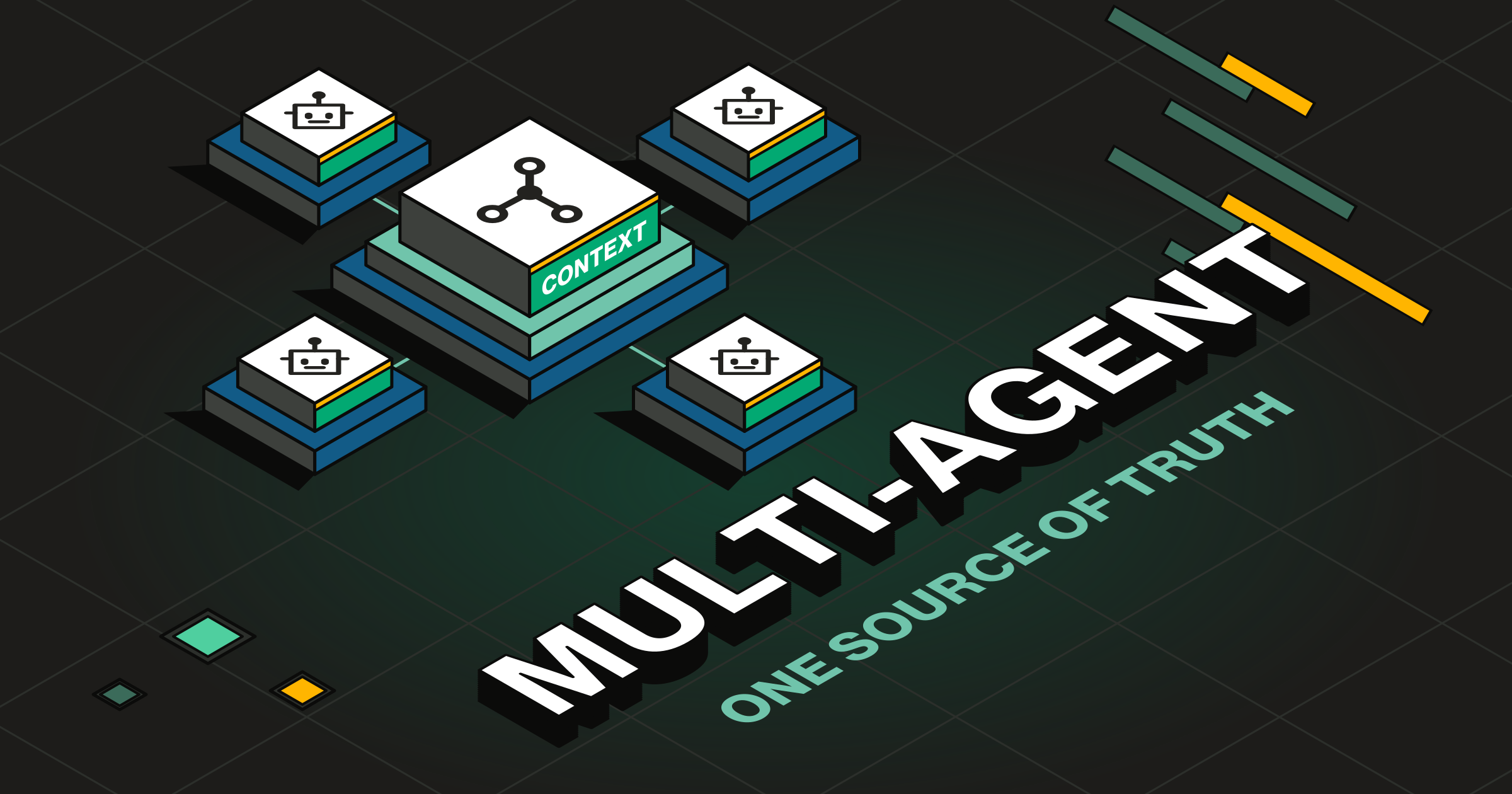
Multi-agent AI systems are supposed to divide work and move faster, but many of them stall out in a different way: the agents start disagreeing with each other. One agent reports a metric that does not match another agent's version of the same metric. A planning agent assigns work based on a customer record a different agent has already revised. Two agents resolve the same support ticket with contradictory answers. The usual response is to blame the model, swap in a larger one, or add more orchestration logic between agents. That rarely fixes it, because the real failure is multi-agent data context: each agent is reasoning from a different, ungoverned view of the same underlying data. Left unresolved, this turns every multi-agent deployment into a debugging exercise that looks like a reasoning problem but is actually a governance gap. Fixing the coordination failure means giving every agent in the system the same governed, code derived context to reason from, not a better prompt or a larger model for any one agent.
When a multi-agent system produces contradictory outputs, teams typically start by tuning prompts, adding a verification agent, or upgrading to a larger model. That approach treats the disagreement as a reasoning failure inside one agent, when the actual cause usually sits upstream of any model. Each agent in the system is often pulling from a different source: one queries a warehouse snapshot taken overnight, another calls a live transactional API, and a third reads from a cache that has not refreshed. None of those sources agree on definitions, freshness, or lineage, so the agents cannot agree either. No amount of additional reasoning capacity fixes a disagreement that originates in the data layer, not the model layer.
Most governance tooling describes data as it lands in a warehouse: table names, column types, and a catalog entry. That is useful, but it says nothing about how a value was derived across the application code, transformation scripts, and established systems that produced it, and Foundational's purview covers any code that touches data, not just pipelines. When one agent reasons from a warehouse table and another goes around the warehouse entirely to query a source system directly, there is no shared definition connecting what either of them sees. Incomplete, warehouse only metadata is exactly the gap that produces the fragmented context multi-agent systems run into.
Foundational is a data and AI governance platform built on source code analysis: it builds a deterministic, code derived map of the full data estate across application code, ORM layers, transformation scripts, established systems, cloud data platforms, and AI and ML workloads. That map, the Foundational Data Graph, becomes the one governed source every agent in a multi-agent system can query against instead of each agent inferring context from a different downstream copy. Agents built on top of it inherit matching definitions, lineage, and freshness by construction. They agree with each other not because an orchestration layer forced them to reconcile their answers after the fact, but because they were never working from different ground truth in the first place.
Multi-agent data context is the shared set of data definitions, lineage, and freshness information that every agent in a multi-agent AI system draws on so their individual outputs stay consistent with each other. It is distinct from any single agent's context window or retrieved documents, which only describe what one agent sees at one moment. Multi-agent data context has to hold across every agent in the system, update as the underlying data changes, and trace back to where each value actually originated, which is why it depends on governed, code derived lineage rather than a snapshot any one agent happens to retrieve.
Good multi-agent data context starts with analyzing the code that produces the data agents consume, not only the tables that code eventually lands in. Foundational's source code analysis traces a value back through the application layer, the transformation logic, and any established system involved, so every agent working against the resulting data graph inherits the same definition and the same lineage, regardless of which agent retrieves it or when. This is the same discipline that accelerated regulatory approval for Lemonade's AI driven underwriting: complete lineage gave the governance team confidence in what the AI was reasoning from, which is the same requirement a multi-agent system has to meet internally before its outputs can be trusted externally.
| Symptom in production | Likely root cause | What actually fixes it |
|---|---|---|
| Two agents report different values for the same metric | Each agent queries a different downstream copy of the data | A single, code derived data graph both agents query against |
| An agent acts on a record another agent already changed | No shared, real time lineage connecting the two agents' views | Deterministic lineage that reflects changes across the data estate |
| Agents give contradictory answers to the same question | Ungoverned context pulled from warehouse metadata alone | Context sourced from source code analysis, not table scans |
The model is usually not the cause. Each agent typically retrieves context from a different source, such as a warehouse snapshot, a live API, or a cache, and those sources rarely agree on definitions or freshness. Swapping models does not change what data each agent is working from, so the disagreement persists until every agent draws on the same governed data context.
Yes. A single agent hallucinating invents information that is not grounded in any source at all. A multi-agent context problem is different and often harder to spot: every agent is grounded in a real source, but the sources disagree with each other on definitions, freshness, or lineage. The fix is not better grounding for one agent in isolation. It is a shared, governed data context that every agent in the system draws on, so agreement is structural rather than something an orchestration layer has to enforce after the fact.
Not on its own. A vector store or a longer context window changes how much an agent can retrieve at once, not whether what it retrieves matches what another agent retrieves. Multi-agent data context requires governed lineage connecting every agent's retrieval sources back to a common, code derived definition. Without that lineage, a bigger context window just lets each agent hold more of its own, still disconnected, version of the data.
Source code analysis traces how a value was produced across application code, transformation scripts, and established systems, rather than only describing where it eventually landed in a warehouse. When every agent's context is built from that same code derived graph, their outputs stay consistent with each other because they are reasoning from the same governed ground truth, not independent, ungoverned copies pulled from whichever source each agent happened to query.
Multi-agent coordination failures are rarely a sign that the agents need to reason harder. They are a sign that the agents are reasoning from different, ungoverned views of the same data. A deterministic data graph built on source code analysis, read more in what makes an AI agent data aware and in the benchmark proof that code and data graphs beat smarter models, gives every agent in the system the same governed starting point instead. Teams planning a multi-agent rollout can request a demo to see how Foundational maps their own application code and established systems into a single governed data graph before agents are given access to it.
Request a demo to see how Foundational maps your application code into a governed data graph.
Request a demo to see how Foundational maps your application code into a governed data graph.
Request a demo to see how Foundational maps your application code into a governed data graph.