Table of Content

Subscribe to our Newsletter
Get the latest from our team delivered to your inbox
Thank you! Your submission has been received!
Oops! Something went wrong while submitting the form.
Ready to get started?
Try It Free
An enterprise AI agent can hold a flawless prompt and still hand back the wrong answer. The reason is rarely the model. It is the data underneath the answer: a metric calculated in one system, moved through three pipelines, and renamed twice before it reached the agent's context window. If the agent cannot trace that path, it is reasoning from a label, not from the data itself.
Most conversations about agent reliability focus on prompt design, retrieval quality, or model choice. Those matter, but they sit on top of a harder problem: does the agent know where a piece of data came from, what transformed it, and what else depends on it? That capability is data awareness, and it is separate from how well an agent is prompted or how much it can retrieve. This post defines what data awareness actually requires, why retrieval alone does not deliver it, and what a genuinely data-aware agent looks like in practice.
A prompt tells an agent what to do. It does not tell the agent whether the data it is about to use is current, complete, or even the right field. Consider an agent asked to summarize a customer's churn risk. The prompt is clear. The retrieval step successfully pulls a "risk_score" field. What the prompt cannot supply is the fact that the field was deprecated six weeks earlier in favor of a recalculated version living in a different table, or that the original field is still populated by a batch job nobody remembers turning off.
This is not a hypothetical edge case. It is the default condition of most enterprise data estates, where fields get renamed, pipelines get rerouted, and ownership changes without a corresponding update to every system that reads from them. An agent operating only on retrieved text has no way to detect any of this. It answers with confidence because nothing in its context signaled a problem.
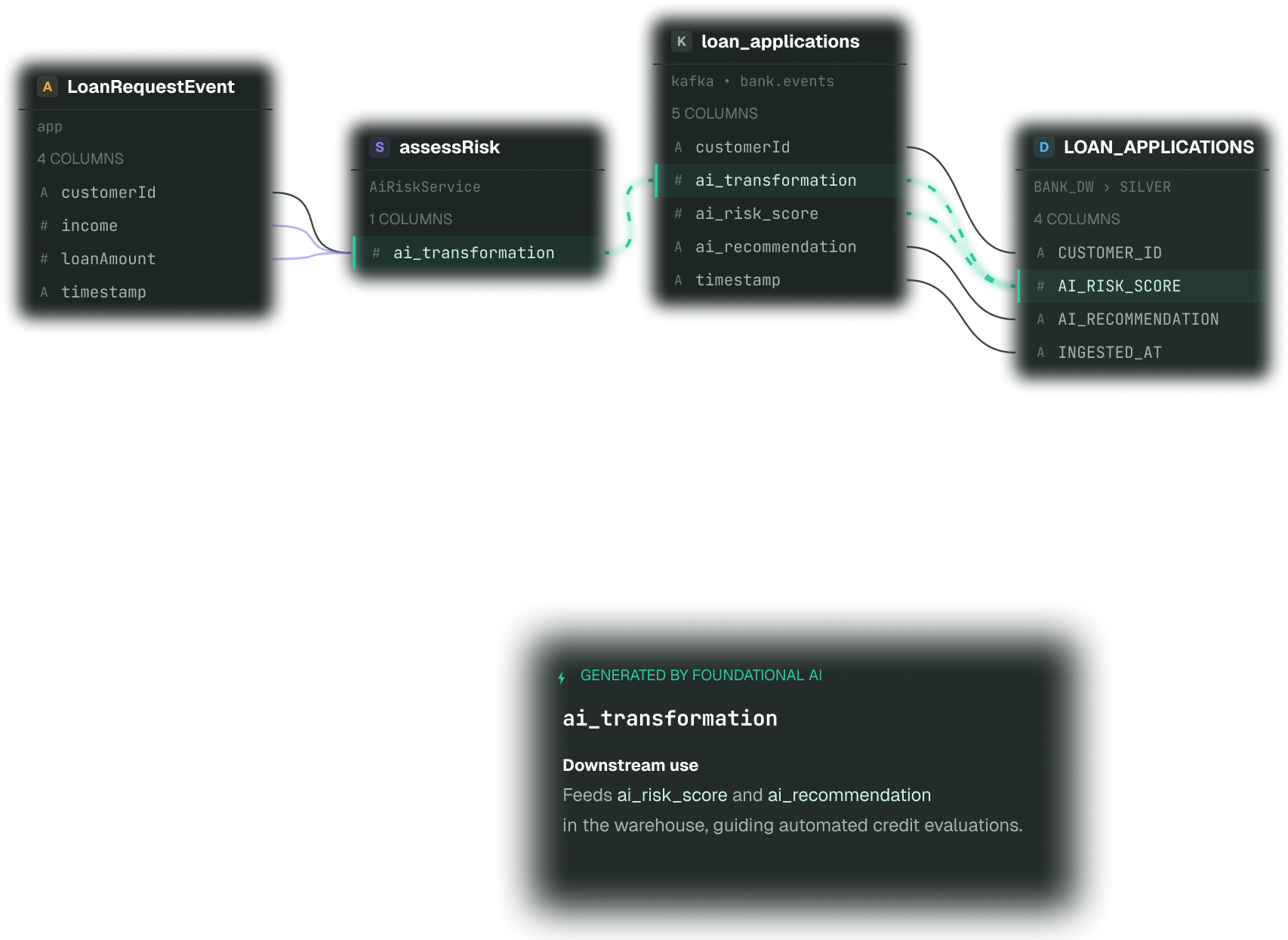
Data awareness means an agent can answer three questions before it acts on a value: where did this come from, what transformed it, and what else reads from it. Answering those questions requires more than a retrieval index over documentation. It requires a structural map of the data estate itself.
Data provenance is the traceable record of where a specific data value originated and every transformation it passed through before reaching its current form. A complete provenance record identifies the source system, the code or pipeline step that changed the value, and the timestamp of each transformation, so a consumer, human or agent, can verify the value rather than assume it.
Provenance is what separates a citation from a fact check. A retrieval-augmented agent can cite the table a value came from. It cannot tell you whether that table is still the authoritative source, unless the provenance chain behind it is mapped from the actual code and pipelines that built it, not from a wiki page someone forgot to update.
| Dimension | Prompt and retrieval context | Data aware context |
|---|---|---|
| Source | Whatever document or table the retriever ranks highest | The verified system of origin, traced from code |
| Freshness | Assumed current unless stated otherwise | Confirmed against the last pipeline run that touched the value |
| Dependencies | Not visible to the agent | Mapped, so the agent knows what else reads from the same field |
| Sensitivity | Inferred from field naming, if at all | Known from code-level classification, not guesswork |
When an enterprise AI agent produces a wrong but confident answer, the postmortem usually blames the model. In practice, the more common failure is a governance gap: no system exists that gives the agent a code-derived, deterministic map of how data moves and changes across the estate. Warehouse-level metadata catalogs describe where data lands. They do not describe the application code, transformation scripts, or established systems that produced it in the first place, so an agent working from catalog metadata alone is working from an incomplete map by definition.
This is the same gap that shows up in benchmark testing of enterprise AI coding agents, where agents equipped with a code and data graph consistently outperformed agents relying on model capability alone. The pattern holds beyond coding agents: any agent that acts on enterprise data needs the same structural context to be dependable.
A data aware agent is backed by a data graph built from source code analysis, not from a manually maintained catalog. Foundational analyzes the actual code that touches data, application layers, transformation pipelines, notebooks, established systems, and AI workloads, and builds a deterministic map of how every field moves, changes, and gets consumed. That graph is what an agent calls into for provenance, dependency, and sensitivity context before it acts, rather than treating a retrieved passage as ground truth.
Ramp saw this play out in practice at engineering scale: after adopting Foundational's code-derived lineage, the company's build success rate improved from 85 percent to 95 percent, according to Kevin Chao, Analytics Engineering Lead, across a team of 40-plus engineers shipping more than 100 pull requests weekly. The same structural visibility that makes a build reliable is what makes an agent's answer about that data reliable.
What does it mean for an AI agent to be data aware?
A data aware agent can trace where a piece of data originated, what code or pipeline transformed it, and what else depends on it, before using that data in a response or action. This goes beyond retrieving a relevant document. It requires a structural, code-derived map of the data estate that the agent can query for provenance and dependency information in real time.
Is retrieval-augmented generation the same as data awareness?
No. Retrieval-augmented generation finds and surfaces relevant text or records for a model to reason over. Data awareness is a separate capability: knowing whether that record is current, where it came from, and what it affects. An agent can have excellent retrieval and still lack data awareness if nothing maps the provenance behind what it retrieves.
Can better prompts fix an agent that lacks data context?
No. A prompt controls what the agent is asked to do, not what the agent actually knows about the data it uses. No amount of prompt engineering substitutes for a governed, code-derived map of how data moves through the enterprise. That map has to exist independently of any single prompt or query.
What proof does data awareness require, beyond a citation?
A citation names a source. Proof of data awareness requires a full provenance chain: the origin system, every transformation step with its source code, and the current dependents of that value. Foundational builds that chain directly from source code and metadata, so it reflects the system as it actually operates rather than as documentation claims it operates.
Enterprise AI agents are only as reliable as the data context behind them. If that context comes from a catalog description instead of the actual code and pipelines that move the data, the agent is reasoning from an assumption, not a fact. See how Foundational's data graph gives agents that missing layer of context in a demo, or read how the same graph held up under independent agent benchmark testing.
Book a demo to see how Foundational's data graph gives AI agents verified data context.
Book a demo to see how Foundational's data graph gives AI agents verified data context.
Book a demo to see how Foundational's data graph gives AI agents verified data context.