Table of Content

Subscribe to our Newsletter
Get the latest from our team delivered to your inbox
Thank you! Your submission has been received!
Oops! Something went wrong while submitting the form.
Ready to get started?
Try It Free
Every AI agent vendor right now is racing to plug an agent into a metadata layer and call it context. I have gone through a handful of these pitches this year, and the one I keep coming back to is a familiar one: package the warehouse metadata, tables, columns, tags, lineage as recorded in the catalog, into an MCP server, and let the agent query it directly. It is a clean pitch, and it reads well on a slide. It is also missing a layer that will matter the moment an agent starts making decisions instead of just answering questions. Warehouse metadata is insufficient for AI agent reliability because it tells an agent where data lives, not what the data means. The real data foundation for AI agents lives one level deeper, in the source code that defines and shapes a field before it ever reaches the warehouse. That is the argument I want to make here, plainly, before getting into where I think the metadata-only pitch actually breaks down.
I think the metadata-only argument is true for a narrow slice of questions. Where does this table live. Who owns it. When was it last refreshed. Warehouse metadata answers those well, and any agent that can query a catalog directly is better off than one that cannot.
It does not answer what a field actually means. A column called risk_score in the warehouse might be calculated three different ways depending on which pipeline populated which row, and that calculation lives in code, not in a catalog tag. The catalog will tell an agent the column exists. It will not tell the agent which version of the calculation produced the value it is about to reason over. Here is the distinction in short form:
| Warehouse metadata | Source-code-derived context | |
|---|---|---|
| What it captures | Table names, column names, tags, refresh timestamps | The actual transformation logic that defined and shaped the field |
| Where the answer lives | The catalog, recorded after the fact | Source code: transformation scripts, ORM mappings, pipelines |
| Question it answers | Where does this data live, who owns it | What does this field mean, how was it calculated |
| Failure mode alone | Agent reasons confidently from an incomplete definition | None, this is the complete picture the agent needs |
Business logic, the actual definition of what a field means and how it got that way, lives in source code. Transformation scripts, ORM mappings, the pipelines that shape raw data into whatever the warehouse eventually stores. A metadata layer built on top of the warehouse, no matter how well designed the MCP server around it is, sees only where data landed. It does not see where that data originated or the logic that shaped it along the way.
Here's the plain version of the term I keep using: deterministic lineage is lineage traced directly from source code rather than reconstructed from query logs or warehouse metadata. It captures the exact transformation logic that shaped a field, not just the fact that the field exists, which is why it holds up as evidence when an agent's output has to be explained or audited.
For a VP of Data or a CDO, here is the consequence that actually matters. An agent that reasons from warehouse metadata alone can produce a confident, well formatted, entirely wrong answer, and there will be no error in any log to catch it. Nothing failed. The agent just inherited an incomplete definition and did not know it was incomplete. That shows up in a regulatory review, not in a unit test.
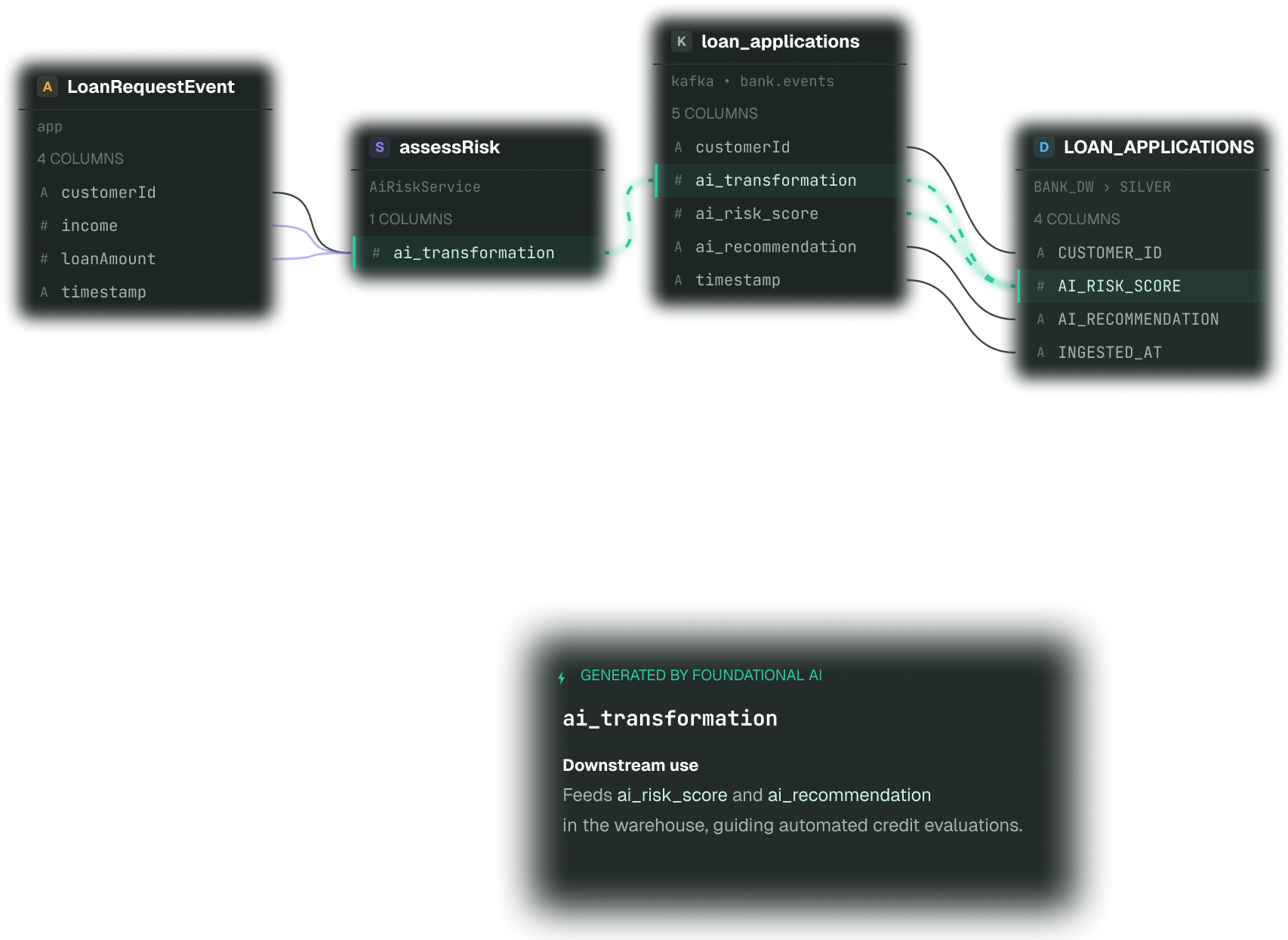
Good agent context is built from source code analysis, not warehouse metadata alone. That means tracing a field back through every transformation script, ORM mapping, and pipeline that touched it, so the definition an agent receives is the same one an engineer would give you if you asked them to explain the field directly. This is the same argument behind what makes up a real data foundation for AI. Foundational runs this analysis across established systems and cloud pipelines alike, which is part of what let Lemonade significantly accelerate regulatory approval for AI-driven underwriting: the lineage behind every model input was already documented and defensible before the review started, not reconstructed under deadline.
This is not a knock on building good metadata infrastructure. Metadata infrastructure and source level context are answering two different questions, and only one of them is enough to trust an agent's output.
Why is warehouse metadata not enough context for an AI agent? Warehouse metadata records where data lives and basic attributes like table ownership and refresh timing, and I use that information constantly, it is genuinely useful for a real set of questions. What it does not capture is the business logic that defines what a field means or how it was calculated, because that logic lives in source code, not in the warehouse. An agent reasoning from metadata alone can misread a field with total confidence, and nothing in the metadata layer would flag it.
What is the difference between warehouse metadata and source code derived context? My short answer is that warehouse metadata describes data as it exists at rest, while source code derived context traces how a field was defined and transformed before it ever reached the warehouse. The second one uses deterministic lineage built from the actual transformation logic, not something reconstructed after the fact from query patterns or table names. I think of the first as a snapshot and the second as the history that explains the snapshot.
Does this mean metadata catalogs and MCP servers are not useful for AI agents? No, and I want to be clear about that. They answer real questions about where data lives and who owns it, and an agent should absolutely be able to query them. They are just answering a different question than what a field means, and an agent needs both pieces to reason reliably, not one instead of the other. Treat metadata as the map and source code as the terrain.
How does source code analysis improve AI agent reliability? It gives an agent the same definition of a field that the engineer who built the pipeline would give you directly, rather than the definition a catalog happened to record after the fact. That closes the gap between an answer that sounds confident and one that is actually correct, which is the gap I think matters most once agents start acting on what they read.
If your AI agent strategy depends on a metadata layer that only sees where data landed, not where it originated, it is worth asking what happens the first time an agent reasons confidently from a field whose real definition changed months ago in a pipeline nobody flagged. See how Foundational's cross-platform lineage traces that definition from source, so agent context stays accurate as pipelines change.
See how Foundational traces deterministic lineage from source code so agents reason from accurate context.
See how Foundational traces deterministic lineage from source code so agents reason from accurate context.
See how Foundational traces deterministic lineage from source code so agents reason from accurate context.