Table of Content

Subscribe to our Newsletter
Get the latest from our team delivered to your inbox
Thank you! Your submission has been received!
Oops! Something went wrong while submitting the form.
Ready to get started?
Try It Free


A model can be state of the art and still produce an answer no one in the room can defend, because the data foundation underneath it was never built to survive scrutiny. Boards are approving AI budgets faster than governance teams can answer a simple follow up question: where did this model's input data actually come from, and can that be proven end to end.
That question is not academic. Regulators enforcing the EU AI Act, internal audit committees, and customers relying on AI driven decisions are all converging on the same requirement: AI trust depends on data trust, and data trust requires full cross-platform lineage and complete metadata, not a warehouse level summary of where data currently sits. A model trained or fed on data whose true origin cannot be traced is a governance liability with a machine learning interface.
This post covers what a genuine AI data foundation requires, where most current approaches fall short, and what complete coverage looks like for a team that needs to defend its AI systems under real scrutiny.
Every argument about AI governance eventually reduces to the same dependency: a model is only as trustworthy as the data that trained it and the data it reasons over at inference time. AI trust depends on data trust. Data trust requires full cross-platform lineage and complete metadata, tracked from the moment data is created through every transformation it undergoes before it reaches a model.
This is why data foundation work cannot be treated as a separate workstream from AI governance. They are the same problem stated twice. A governance program that stops at describing what data a model uses, without tracing where that data actually originated, cannot answer the questions regulators and auditors are already asking about AI systems in production today.
Most teams describe their data as AI ready once it is cataloged, tagged, and accessible inside a central warehouse or lake. That work is necessary but it answers a narrower question than the one AI governance actually requires: where is the data, not where did the data come from.
A catalog built to search and tag warehouse tables was never designed to trace a value back through the Python feature pipeline, the Java service, or the ORM mapping that produced it. Catalog tools see only where data lands. Foundational sees where it originates, and for AI systems specifically, that gap is exactly where unverifiable model inputs live.
Deterministic lineage is lineage derived directly from the source code that performs a transformation, rather than inferred from logs, samples, or naming conventions. Because it is read from the actual instructions a program executes, it produces the same, exact path every time, with no probabilistic guessing about which input fed which output.
For an AI data foundation, this distinction is the difference between telling a regulator "our metadata suggests this is the source" and telling them "this is the exact code path this value traveled, and here is the evidence." Only one of those statements holds up in an audit or an AI incident review.
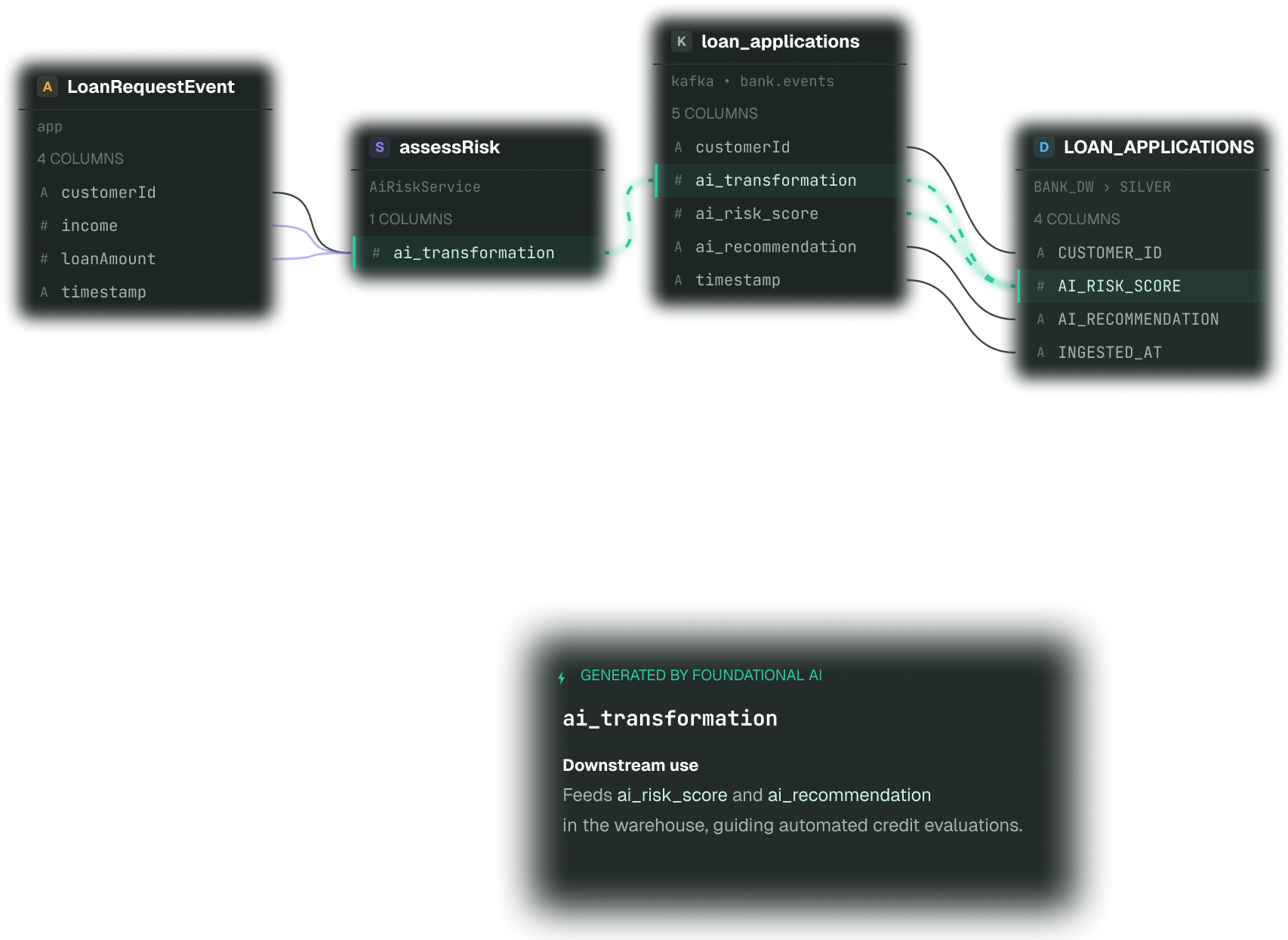
A genuine AI data foundation requires lineage and metadata that is complete across every system a model's inputs touch, from the application code that created a value through every pipeline it passed through before reaching a feature store or prompt. Foundational is the only data and AI governance platform that analyzes source code directly, including SQL, Python, Java, Scala, and the ORM layer, to build that foundation from the point of origin rather than from a warehouse snapshot.
The Governance Readiness Model, Foundational's five-layer governance maturity framework, places this capability at the base layer: no AI governance claim above it holds without deterministic lineage underneath. Ramp used this approach to raise its build success rate from 85 percent to 95 percent, according to Kevin Chao, Analytics Engineering Lead at Ramp, a direct measure of how much more reliable a data foundation becomes once lineage is traced from source rather than inferred after the fact.
Here is what changes when a data foundation is traced from source code rather than assembled from warehouse metadata alone:
• Origin visibility: a warehouse-only foundation starts at the warehouse table, while a source code traced foundation starts at the code that created the value.
• Lineage type: a warehouse-only foundation is inferred from logs and metadata, while a source code traced foundation is deterministic, read directly from source code.
• AI input verification: a warehouse-only foundation cannot confirm the true origin of features, while a source code traced foundation traces every feature back to its source.
• Audit evidence: a warehouse-only foundation offers a metadata snapshot, while a source code traced foundation offers a full origin-to-output code path.
What does a data foundation for AI actually require from a governance perspective?
It requires complete, deterministic lineage and metadata covering every system an AI model's inputs touch, traced back to the source code that created each value, not just a catalog of where data currently sits in a warehouse. Without that, a governance team cannot verify what data actually shaped a model's outputs.
Why isn't a data catalog enough to make data AI ready?
A data catalog indexes and searches metadata that already exists inside a warehouse, which answers where data is but not where it came from. AI systems consume features frequently engineered in Python or application code, so a foundation built only from warehouse metadata cannot verify the true origin of a model's inputs.
How does this connect to EU AI Act compliance?
The EU AI Act and similar frameworks increasingly require organizations to document the provenance of data used in AI systems, not just describe the model's behavior. Deterministic lineage that traces model inputs back to their source code origin is the evidence base that kind of documentation requires.
What is the Governance Readiness Model?
The Governance Readiness Model is Foundational's five-layer framework for governance maturity, with deterministic lineage and complete metadata forming the base layer that every higher-layer AI governance claim depends on. A team cannot claim AI trustworthiness at the top of the model without solving lineage at the bottom.
Can an existing data warehouse or lake investment be reused while closing this gap?
Yes. Closing the AI data foundation gap does not require replacing an existing warehouse, lake, or catalog. Source code analysis adds the origin level lineage those systems were never built to provide, layering on top of existing infrastructure rather than replacing it.
An AI system is only as defensible as the data foundation underneath it, and that foundation has to trace back to source code, not just summarize where data already landed in the warehouse. See how Foundational's AI governance approach builds that foundation from origin, or request a demo to see deterministic lineage mapped against your own AI pipelines.
Request a demo to see deterministic lineage mapped against your own AI pipelines.
Request a demo to see deterministic lineage mapped against your own AI pipelines.
Request a demo to see deterministic lineage mapped against your own AI pipelines.