Table of Content

Subscribe to our Newsletter
Get the latest from our team delivered to your inbox
Thank you! Your submission has been received!
Oops! Something went wrong while submitting the form.
Ready to get started?
Try It Free


Data contracts are formalized agreements that define the relationship between data producers and consumers, specifying the structure, ownership, and expectations for data products. They serve a function analogous to APIs in software, providing a standardized way to ensure predictable and reliable data flows across teams and systems. With the increasing reliance on data-driven decision-making in analytics, data science, and engineering, data contracts have become indispensable for preventing disruptions and maintaining data quality.
Consider this common scenario: the analytics team assumes that revenue data in the warehouse is refreshed daily because their reports depend on up-to-date information. However, the team responsible for generating that data updates it only weekly. This disconnect can lead to erroneous analyses, missed opportunities, and operational headaches. Data contracts formalize such assumptions into explicit agreements, aligning all stakeholders on their roles, responsibilities, and expectations. This clarity is critical for avoiding chaos and ensuring that data consumers can rely on the data they use.
The shift to distributed data ownership has transformed data architectures, empowering domain-specific teams to own and manage the data they produce. This new approach highlights the need for explicit agreements between producers and consumers, which data contracts formalize. By implementing these agreements, organizations can enforce quality at the source, scale distributed architectures efficiently, and enable central teams to focus on building scalable validation frameworks.
Data contracts also foster collaboration, ensuring shared accountability and minimizing operational chaos as data flows through the organization.
ODCS (Open Data Contract Standard) is an open-source framework, licensed under Apache 2.0, that provides a standardized approach to defining data contracts. Originally developed by PayPal to support its Data Mesh initiatives, ODCS is now part of the Linux Foundation’s Bitol project.
ODCS offers a comprehensive framework for managing:
One of ODCS’s biggest advantages is its open standard, which prevents vendor lock-in and supports a wide array of tools. For example, while dbt’s model contracts are a step forward, they apply only to dbt models, leading to fragmented contract definitions across an organization. ODCS ensures consistency and adaptability, allowing organizations to build a unified data contract framework.
An example of a data contract, taken from ODCS GitHub:

Even the best-defined data contracts lose value if they are not enforced. Enforcement ensures contracts remain relevant, actionable, and trusted by both producers and consumers.
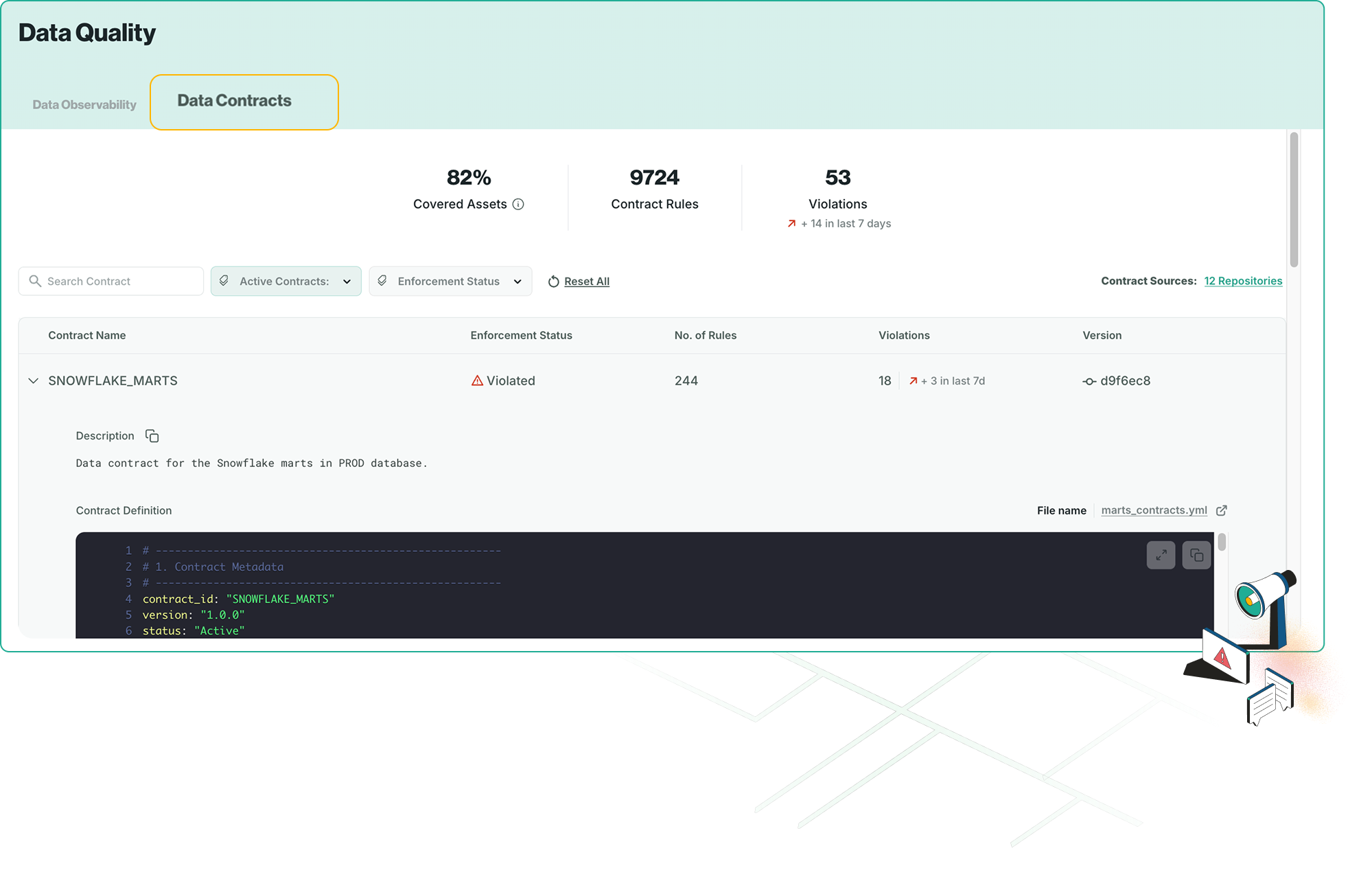
At Foundational, for instance, proactive enforcement analyzes pipeline code changes to identify potential violations early. By combining proactive validation with reactive monitoring, organizations can build a robust enforcement strategy that minimizes disruptions.
Implementing data contracts across an organization’s entire data landscape can feel overwhelming. To avoid analysis paralysis, start small:
This incremental approach allows teams to see the benefits of data contracts including reduced incidents, improved reliability, and smoother collaboration, without committing to a massive overhaul all at once.
Rolling out data contracts across a handful of pipelines is straightforward. Rolling them out across hundreds of producers and thousands of downstream consumers is a different problem. At enterprise scale, three things tend to break a rollout: inconsistent contract definitions across teams, no reliable way to detect when a producer's code no longer matches its published contract, and enforcement that only catches violations after they reach production.
Standardizing on an open format like ODCS solves the first problem. The second and third require visibility into the code that produces the data, not just the data itself. A contract defined in a YAML file is only as trustworthy as the pipeline code that is supposed to honor it, so enterprise rollouts need a way to check contract compliance against the actual source code change, before it merges.
Teams that scale data contracts successfully tend to sequence the rollout by business impact rather than by team. They start with the datasets that feed executive reporting or regulatory filings, expand contract coverage from there, and use automation to keep contract definitions current as pipelines evolve, instead of relying on a quarterly manual audit.
A few practices separate data contracts that hold up in production from ones that quietly go stale:
At Lightricks, proactive analysis of pipeline code changes prevents roughly 100 issues each month across more than 150 pull requests, according to Eyal El-Bahar, VP of BI and Analytics. That is the kind of enforcement data contracts need to actually hold: checked at the code change, not after the data has already shipped.
Most data contract tooling validates schema and freshness after data lands in the warehouse. That catches problems only after they have already affected downstream consumers. Foundational, a data and AI governance platform, analyzes the source code that produces the data directly, so a contract violation introduced by a pipeline change is flagged at the pull request, before it merges and before any bad data ships. This is only possible because the analysis happens at the code layer rather than the query log layer, where most lineage and validation tools operate.
Data contracts are the foundation for reliable, scalable, and collaborative data architectures in growing organizations. By adopting standards like ODCS, enforcing agreements proactively, and approaching implementation incrementally, companies can unlock the full potential of their data assets. With data contracts in place, organizations can achieve fewer disruptions, better collaboration between teams, and enhanced data quality, all while supporting the complexities of distributed ownership and evolving data architectures.
At enterprise scale, data contracts work best when defined in an open, tool agnostic standard like ODCS, versioned alongside the pipeline code that implements them, and enforced automatically at the pull request stage rather than checked manually after deployment. Teams that succeed typically sequence rollout by business impact, starting with the datasets that feed executive or regulatory reporting.
The core best practices are versioning contracts with code, validating compliance before merge rather than after deployment, assigning ownership at the contract level rather than the team level, automating contract generation for existing pipelines, and treating violations as a blocked build rather than an alert to triage later.
Manually implementing data contracts across an existing data estate commonly takes 12 months or longer when done by hand, since every producer's schema, ownership, and SLA has to be documented individually. Automated tools that analyze lineage and schema history can bootstrap contract definitions for existing pipelines in hours rather than months.
No. A data catalog indexes and documents data assets after they exist. A data contract is a proactive agreement between a producer and consumer about what that data will look like and when it will arrive, enforced before a change ships rather than documented after the fact.
Effective enforcement requires visibility into the pipeline code itself, not just the resulting data it produces. Foundational analyzes pipeline source code directly, so contract violations are caught at the pull request stage, before a schema or logic change reaches production.