Table of Content

Subscribe to our Newsletter
Get the latest from our team delivered to your inbox
Thank you! Your submission has been received!
Oops! Something went wrong while submitting the form.
Ready to get started?
Try It Free
Category I through III banking organizations file FR 2052a, the Federal Reserve's Complex Institution Liquidity Monitoring Report, on a daily or monthly basis depending on tier. The report demands granular balance sheet, funding, and collateral data reported consistently across every legal entity in the organization. Getting one line wrong is not a rounding error. It is a data point examiners use to assess whether a bank actually understands its own liquidity position.
Most banks assemble FR 2052a by pulling data from core banking systems, treasury platforms, and collateral management tools, then reconciling it by hand or in spreadsheets before submission. That reconciliation step is where accuracy risk and exam trail risk both live. If a liquidity risk team cannot show precisely how a submitted number traces back to its source system, an examiner has no reason to trust that it is correct even when it is.
Deterministic data lineage closes that gap. Instead of reconstructing the path from source to submission after the fact, it traces every reported line item to the exact system, table, and transformation logic that produced it, before an examiner ever asks the question.
FR 2052a (OMB control number 7100-0361) is the Fed's primary tool for monitoring the liquidity position of large, complex banking organizations. Category I and II institutions typically report daily, with Category III institutions on a less frequent cycle, but all filers must reconcile granular balance sheet, funding, and collateral data consistently across legal entities, not just at the consolidated level. That cross-entity consistency requirement is what makes FR 2052a harder to satisfy than a single-entity report. The same underlying position has to tie out identically whether it is viewed through the lens of the parent company, a broker-dealer subsidiary, or an international branch.
The data that feeds FR 2052a rarely lives in one place. Core banking ledgers, treasury management systems, and collateral platforms each hold a piece of the picture, and each system has its own transformation logic, its own refresh cadence, and its own definition of terms that sound the same but are not. When a liquidity risk or compliance team reconciles across these systems manually, spreadsheet by spreadsheet, the resulting audit trail is a snapshot of what someone believed was true on the day they built it, not a durable record of how the number was actually calculated.
That gap shows up during exams as a Matter Requiring Attention, or worse, as a restated report. Examiners are not just checking whether the numbers reconcile today. They are checking whether the bank can reproduce and explain that reconciliation on demand, for any reporting period, without depending on institutional memory.
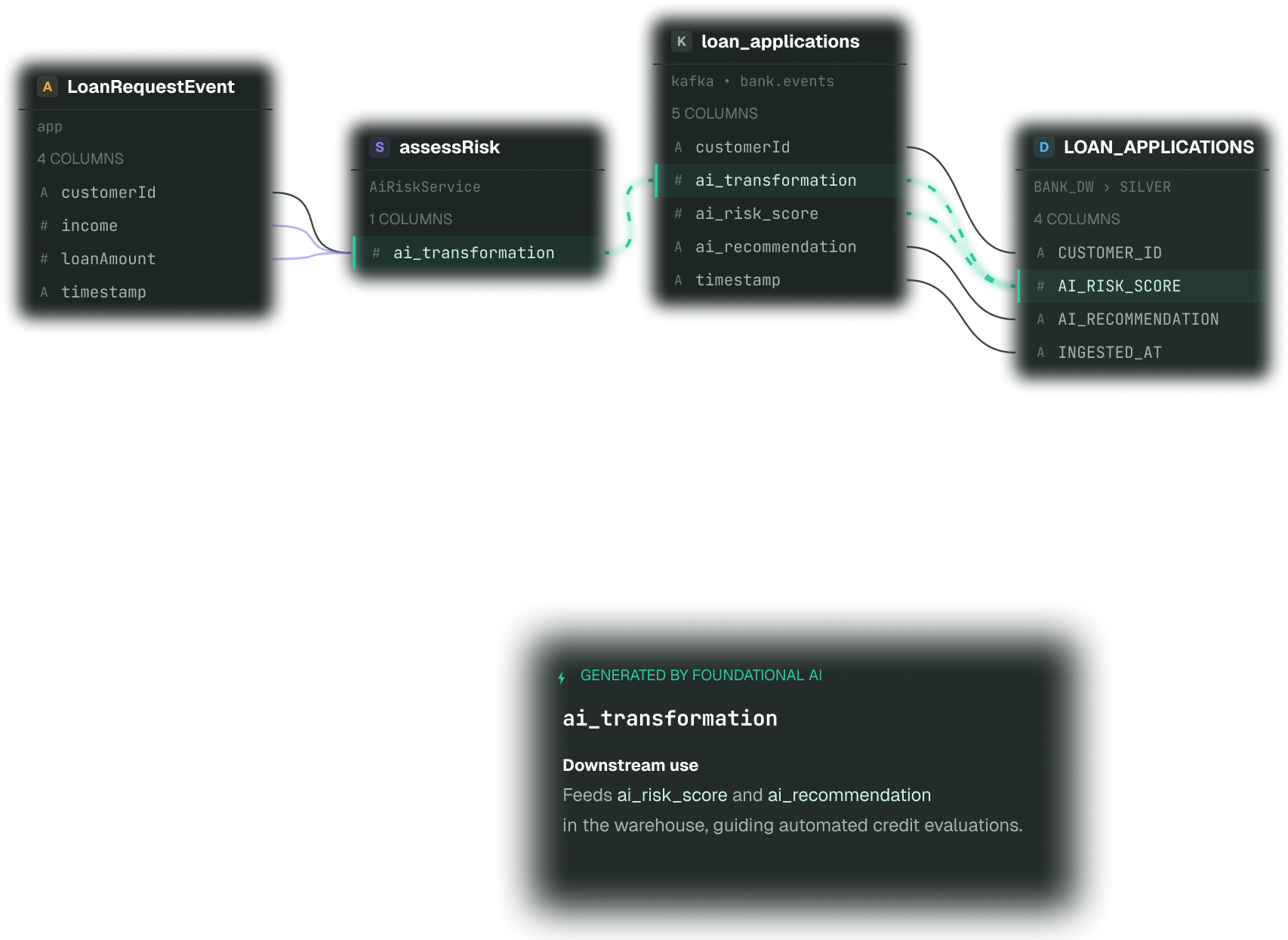
Foundational analyzes the actual application code, transformation scripts, and established core banking systems that calculate each FR 2052a line item, rather than inferring relationships from query logs or relying on documentation someone updated manually. The result is deterministic lineage.
Deterministic lineage is the complete, code-derived path data takes from its source system to a reported value. It is generated by analyzing the actual code and transformation logic that produced a number, not reconstructed from query history or hand-maintained diagrams. For a report like FR 2052a, deterministic lineage means a liquidity risk or compliance team can trace any submitted line item back to the exact source tables, calculations, and systems that produced it, across every legal entity, without waiting for someone to piece the trail together after the fact.
| Manual reconciliation | Deterministic lineage |
|---|---|
| Rebuilt by hand for each reporting cycle | Generated automatically from the code that produces each value |
| Depends on the person who built the spreadsheet | Reproducible by anyone, for any period, on demand |
| Shows what someone believed was true that day | Shows exactly what system and logic calculated the number |
| Cross-entity consistency checked after the fact | Cross-entity consistency traceable at the source |
Complete coverage for a report like FR 2052a means tracing lineage across application code, ORM layers, transformation scripts, and established core banking systems, not just the pipelines that move data between a warehouse and a reporting tool. Foundational builds a live, code-derived map of that entire path, the same data graph that gives liquidity risk and compliance teams a durable, reproducible record instead of a point-in-time reconciliation exercise. Because the map is generated directly from code, it surfaces a change to a calculation or a source system before that change reaches a submitted FR 2052a line item, rather than after an examiner finds it.
Lemonade used this approach to accelerate regulatory approval for AI-driven underwriting, building complete lineage to support compliance-driven governance of a heavily regulated process. The same principle applies to FR 2052a: a governance foundation that can prove, not just assert, where a reported number came from.
FR 2052a requires granular balance sheet, funding, and collateral data that supports the Federal Reserve's assessment of a filing institution's liquidity position. Filers report this data consistently across every legal entity in the organization, not only at the consolidated parent level, which means the same underlying position has to reconcile whether it is viewed through a subsidiary, a branch, or the parent company.
Filing frequency depends on the institution's category. Category I and II banking organizations generally report daily, while Category III institutions report on a less frequent cycle. Regardless of frequency, every filer has to reconcile the same categories of granular liquidity, funding, and collateral data across legal entities each time, which means the reconciliation process has to hold up under a tight, recurring deadline rather than getting rebuilt once a year for a single audit.
Inconsistent data across legal entities or source systems is exactly what examiners look for. Unexplained discrepancies typically surface as a Matter Requiring Attention, and in more serious cases can require a restated report. The underlying issue is usually not the number itself but the inability to show, on demand, exactly how that number was calculated and where it came from.
Only if the lineage is generated from the actual code and transformation logic that produced the number, rather than inferred from query logs or documented by hand. Foundational analyzes application code, transformation scripts, and established core banking systems directly, so a submitted FR 2052a line item can be traced to its exact source tables and calculations across every legal entity.
A data catalog typically documents where data lands, such as a warehouse table or a report field, based on what someone recorded or what a query log shows. Deterministic lineage goes further upstream, tracing the code and transformation logic that produced the value in the first place. For a report like FR 2052a, that difference is the difference between describing where a number sits and proving how it was calculated.
FR 2052a was built to test whether a bank truly understands its own liquidity position, not just whether its spreadsheets tie out once. Deterministic lineage turns that test into a reproducible process instead of a recurring fire drill: every reported line item traceable to its source, across every legal entity, on demand. For a broader look at how lineage supports regulatory reporting in banking, see Data Governance in Banking: What CCAR and BCBS 239 Actually Require and the Deterministic Lineage glossary entry. To see how Foundational maps FR 2052a data to its source systems, request a demo.
Request a demo to see how Foundational maps every reported line item back to the code and systems that produced it.
Request a demo to see how Foundational maps every reported line item back to the code and systems that produced it.
Request a demo to see how Foundational maps every reported line item back to the code and systems that produced it.