Table of Content

Subscribe to our Newsletter
Get the latest from our team delivered to your inbox
Thank you! Your submission has been received!
Oops! Something went wrong while submitting the form.
Ready to get started?
Try It Free

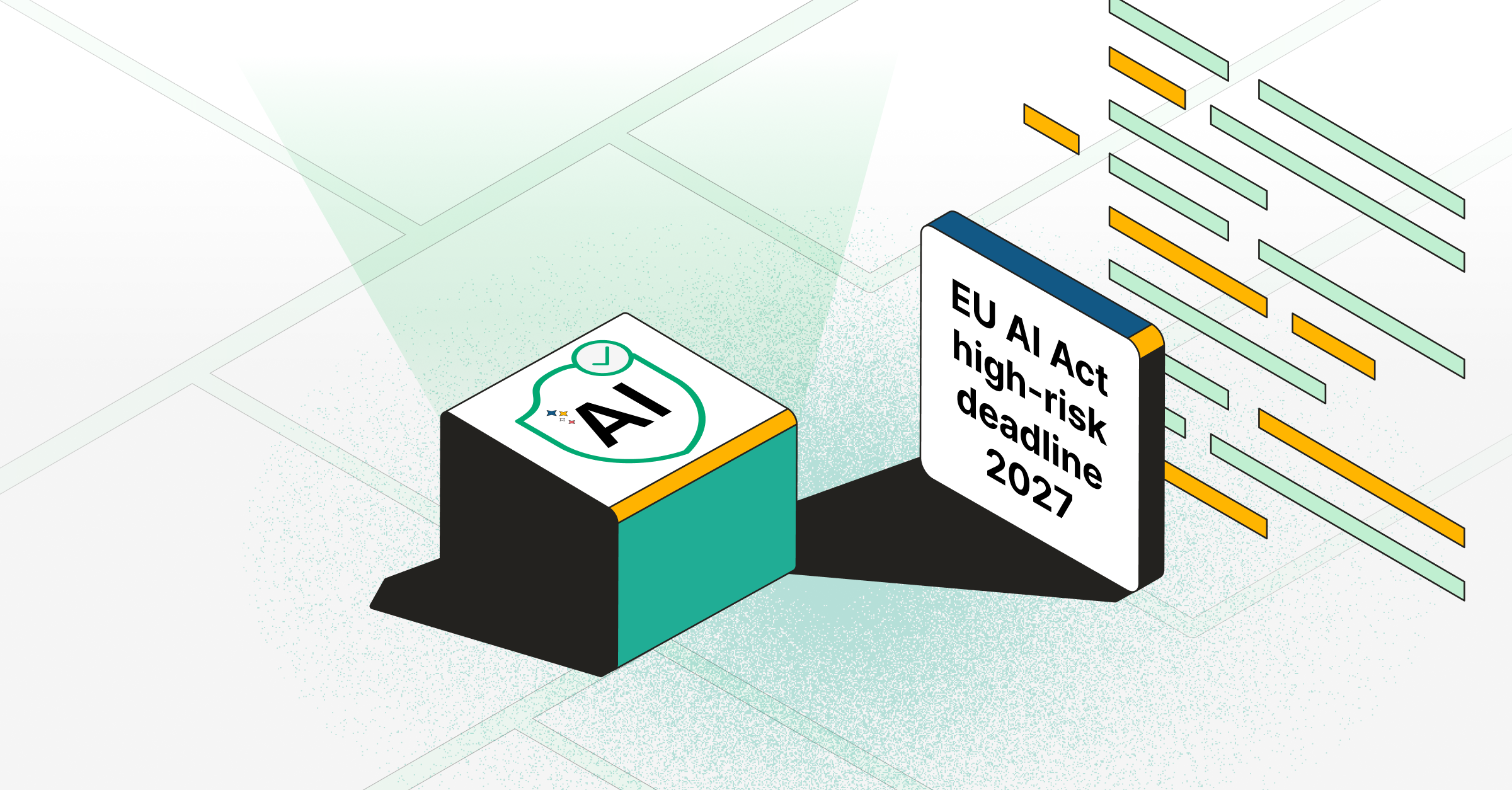
The European Union's high-risk AI deadline just moved from August 2026 to December 2027, and compliance teams building AI driven credit scoring, underwriting, and fraud detection tools face a real risk of reading that shift as relief. It is not relief. The EU's Digital Omnibus on AI, binding law as of the week of July 10, 2026, pushed back the conformity assessment and CE marking deadline for high risk Annex III systems because harmonized technical standards were not ready in time, not because the underlying governance obligations changed. Standalone high risk systems now have until December 2, 2027. Systems embedded in regulated products, including medical devices, have until August 2, 2028.
Meanwhile a different set of obligations, Article 50 transparency rules covering chatbot disclosure, deepfake labeling, and emotion recognition disclosure, along with penalty powers for general purpose AI models, still take effect on the original date: August 2, 2026. A single regulation is now running two clocks at once, and the buyers Foundational serves in banking, insurance, and healthcare need to know which clock applies to them and what the extra runway is actually for.
The Digital Omnibus on AI entered force after the European Parliament approved it on June 16, 2026 and the Council adopted it on June 29, 2026. It defers, rather than removes, the conformity assessment and CE marking requirements for high risk AI systems under Annex III. The table below summarizes what moved and what did not.
| Obligation | Original deadline | Current deadline |
|---|---|---|
| Annex III conformity assessment and CE marking, standalone high risk systems | August 2, 2026 | December 2, 2027 |
| Annex III conformity assessment, systems embedded in regulated products (for example, medical devices) | August 2, 2026 | August 2, 2028 |
| Article 50 transparency: chatbot disclosure, deepfake labeling, emotion recognition disclosure | August 2, 2026 | Unchanged, August 2, 2026 |
| GPAI penalty powers | August 2, 2026 | Unchanged, August 2, 2026 |
Credit scoring, insurance underwriting, and fraud detection AI are classified as high risk under Annex III, which means banking and insurance buyers get the deferred timeline. Healthcare organizations using AI embedded in regulated devices get the longest runway of all, until August 2028. None of this affects the transparency and penalty provisions already active on the original schedule.
AI trust depends on data trust. Data trust requires full cross platform lineage and complete metadata, and that requirement has not moved with the deadline. What a compliance team must eventually prove to pass a conformity assessment, where a high risk model's training and inference data actually originated and how it was transformed along the way, is the same work it was before the Digital Omnibus. A longer deadline changes when that proof is due. It does not change what counts as proof.
Foundational customer Lemonade saw regulatory approval for its AI driven underwriting accelerated significantly once it could show regulators complete, defensible lineage for the data feeding its models, evidence produced through source code analysis rather than assembled after the fact. That is the pattern compliance teams should plan around: the organizations that build lineage infrastructure ahead of enforcement spend the deadline on refinement, and the organizations that wait spend it on a scramble no vendor can compress into a few months.
Deterministic lineage is the exact, code verified path data takes from its point of origin through every transformation until it reaches an AI model or report, established by analyzing the actual source code that moves the data rather than inferring it from query logs or metadata samples.
For an EU AI Act conformity assessment, deterministic lineage is what turns a governance claim into evidence a regulator can check. A team that can show exactly where a credit scoring model's inputs originated, what changed them, and when, is defending a documented fact. A team relying on inferred or sampled lineage is defending a best guess, and a best guess does not hold up under a formal conformity assessment.
Foundational is a data and AI governance platform, and the mechanism behind every claim in this post is source code analysis. Foundational reads the actual code that moves and transforms data, across SQL, Python, Java, dbt, Spark, and AI pipelines, to build lineage that is complete and provable rather than approximated. In the Governance Readiness Model, this is the evidence layer: the difference between describing governance in a policy document and demonstrating it to a regulator on request.
Teams with until December 2027 or August 2028 to reach conformity have more runway than they had a month ago, not less work to do. The deadline moved because the technical standards were not ready, not because proving where AI inputs come from got any less necessary. Building deterministic lineage now, well ahead of the new deadline, is what turns December 2027 and August 2028 into a formality instead of a scramble.
Did the EU AI Act's compliance deadline actually change in 2026?
Yes, for one part of it. The Digital Omnibus on AI, binding law as of July 10, 2026, pushed the conformity assessment and CE marking deadline for high risk Annex III AI systems from August 2, 2026 to December 2, 2027 for standalone systems and August 2, 2028 for systems embedded in regulated products. Article 50 transparency obligations and GPAI penalty powers still take effect August 2, 2026 as originally scheduled.
Which AI systems are covered by the extended high risk deadline?
Annex III high risk systems, including AI used for credit scoring, insurance underwriting, and fraud detection, now have until December 2, 2027 for standalone deployments. Systems embedded in regulated products, such as AI used in medical devices, have until August 2, 2028. Banking, insurance, and healthcare organizations using AI for these purposes fall under the deferred timeline.
Does the delayed deadline mean compliance teams can wait to build AI governance infrastructure?
No. The deadline shift addresses when a conformity assessment is due, not what that assessment requires. Teams still need to prove where a model's training and inference data originated and how it was transformed, evidence that source code analysis and deterministic lineage produce and that a compliance sprint close to the new deadline cannot manufacture on short notice.
What is deterministic lineage and why does it matter for the EU AI Act?
Deterministic lineage is the exact, code verified path data takes from its origin through every transformation before it reaches an AI model, built by analyzing the source code that moves the data rather than inferring it from logs or samples. For an AI Act conformity assessment, it is the difference between documenting a governance claim and proving it.
The EU AI Act's high risk deadline moved because the technical standards were not ready, not because the underlying requirement changed: prove where your AI systems' data actually comes from. Banking, insurance, and healthcare teams with AI in credit scoring, underwriting, fraud detection, or embedded medical devices now have until December 2027 or August 2028 to show that proof, and the teams that start building deterministic lineage now will spend that runway on refinement instead of a scramble. Request a Foundational demo to see what source code analysis based lineage looks like for your AI systems before the new deadline arrives.
Get a demo of source code based lineage built for AI Act conformity assessments.
Get a demo of source code based lineage built for AI Act conformity assessments.
Get a demo of source code based lineage built for AI Act conformity assessments.