Table of Content

Subscribe to our Newsletter
Get the latest from our team delivered to your inbox
Thank you! Your submission has been received!
Oops! Something went wrong while submitting the form.
Ready to get started?
Try It Free
Most COBOL modernization projects do not fail because the code is old. They fail because nobody can say, with confidence, what a given COBOL program actually does before someone changes it. Teams open a modernization initiative with a target architecture already decided, a cloud rehost, a Java rewrite, an API wrapper, and only discover the real dependencies once a batch job breaks a downstream report or a nightly posting run silently miscalculates a balance. On established mainframe systems running core banking, insurance, or claims processing, that kind of surprise is not a bug ticket. It is a regulatory incident.
The fix is not more caution. It is sequencing the project correctly from the start: understand what the system does before deciding what to change, prioritize by what actually depends on what, and keep documentation current as the code moves instead of writing it once and watching it go stale. This roadmap walks through that sequence for a data engineering team planning, or already partway through, a COBOL modernization program.
COBOL modernization is the practice of updating COBOL applications, whether by refactoring the code, wrapping it in APIs, migrating it to a new platform, or rewriting it outright, while preserving the business logic those applications encode. It rarely means replacing an established system wholesale. In most estates it means making a decades-old application observable, testable, and safe to change incrementally, one module at a time, without stopping the transaction volume that estate was built to handle.
Documentation on established COBOL estates is usually outdated, incomplete, or written by someone who has since retired. Business logic accumulates across COBOL programs, copybooks, JCL job steps, and DB2 tables, often with dependencies that were never written down anywhere. Before any migration decision gets made, the team needs an accurate, current picture of what the system does, not what a five-year-old diagram claims it does.
That picture has to cover four kinds of assets at once:
A usage pass across all four typically finds that a small number of programs carry most of the business value, while a large share of the estate has gone dormant. Knowing which is which, before touching anything, is what turns a modernization project from a guessing game into a plan.
Once dependencies are mapped, the natural instinct is to start with whatever looks easiest to migrate. That is the wrong sort order. The right one ranks each candidate module by blast radius, how many other programs, files, and downstream reports would be affected if it changed or broke, and sequences accordingly.
| Convenience-first sequencing | Blast-radius sequencing |
|---|---|
| Migrates whatever is smallest or best understood first | Migrates whatever has the fewest, best-controlled downstream dependencies first |
| Discovers hidden coupling mid-project, often in production | Surfaces hidden coupling during planning, before any code moves |
| Treats every module as equally risky | Reserves the heaviest validation and rollback planning for high-dependency modules |
A batch job that looks low-risk in isolation can still depend on a DB2 table that a separate nightly transaction updates. Without a dependency map, that kind of coupling only shows up after something breaks.
A dependency map produced once, at the start of a project, starts decaying the moment the first module is migrated. Established COBOL estates that rely on point-in-time documentation drift back into the same undocumented state within a year. Version-controlled documentation, generated from the source itself and updated automatically as the code changes, along with CI/CD pipelines that run regression and semantic-equivalence tests on every change, keeps the map accurate for the life of the program, not just for the kickoff meeting.
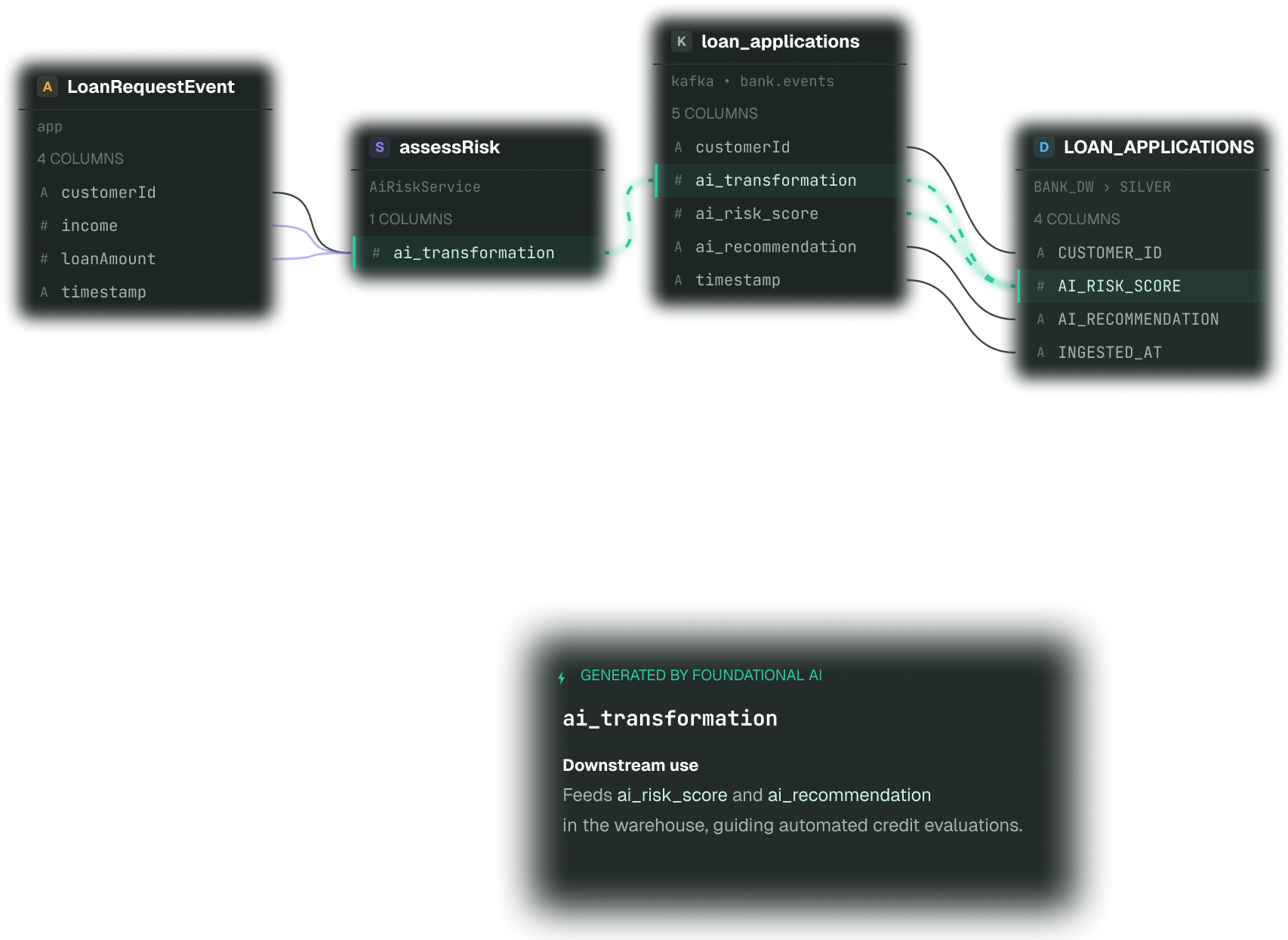
The dependency and lineage maps a modernization project needs cannot come from watching a database or interviewing whoever is left who remembers the system. Foundational, a data and AI governance platform built on source code analysis, builds them by analyzing the COBOL, copybook, JCL, and DB2 source directly, tracing exactly how a field moves from a batch read through every transformation to its final write, without requiring access to production systems. The same source code analysis approach already catches an average of around 100 data issues a month across 150-plus pull requests for customers like Lightricks before those issues reach production. Applied to an established mainframe estate, it turns "we think this is safe to change" into a field-level answer backed by the exact line of code behind it. Foundational's mainframe lineage support, covering COBOL, JCL, copybooks, and DB2, is generally available today.
How long does a COBOL modernization project typically take?
Timelines vary widely with estate size, but the discovery and dependency-mapping phase is the one teams most often underestimate. Estates that automate this mapping instead of doing it by hand tend to move through planning and phased migration faster, because they are not spending months reconstructing what the code already tells them.
Should we rewrite COBOL in Java, or keep it and wrap it with APIs?
Both are valid, and most estates end up doing some of each. Modules with stable, well-understood logic are often good candidates for API wrapping rather than a rewrite. Modules with unclear dependencies or heavy business-rule complexity usually need a dependency map before that decision can be made responsibly either way.
How do we know which COBOL programs are safe to touch first?
Rank programs by blast radius: how many other programs, files, and downstream reports depend on them. Programs with few, well-controlled dependencies are the safest starting point. Programs tied into shared copybooks or DB2 tables that other unrelated jobs also touch belong later in the sequence, once stronger validation is in place.
Do we need production mainframe access to map COBOL dependencies?
No. Dependency and lineage mapping built on static analysis of the source code, COBOL, copybooks, JCL, and DB2 definitions, works without connecting to production systems. For security-sensitive mainframe estates, that is frequently the only mapping approach that is operationally possible to grant access for.
COBOL modernization succeeds or stalls based on how well the project understands the system it is changing before it changes it. Map the dependencies, sequence by blast radius, and keep the documentation alive as the code moves, and a mainframe modernization program stops being a guessing game. Talk to Foundational about mapping field-level lineage and dependencies across your COBOL, JCL, and DB2 estate before your next migration decision.
Get field-level lineage across your COBOL, JCL, and DB2 estate before your next migration decision.
Get field-level lineage across your COBOL, JCL, and DB2 estate before your next migration decision.
Get field-level lineage across your COBOL, JCL, and DB2 estate before your next migration decision.