Table of Content

Subscribe to our Newsletter
Get the latest from our team delivered to your inbox
Thank you! Your submission has been received!
Oops! Something went wrong while submitting the form.
Ready to get started?
Try It Free
When a regulator, auditor, or board member asks where the data behind an AI decision came from, the warehouse only gets you halfway. Most AI governance platforms on the market today index metadata once it lands in the warehouse. They cannot see the Python pipeline that engineered a feature, the ORM layer that pulled a customer record into an application, or the agent workflow that combined both before a model ever touched them. For a CDO or VP of Data accountable for AI trustworthiness, that gap is not a technical footnote. It is the exact place where an audit finding or a regulatory inquiry lands. Complete AI governance platform coverage has to extend past the warehouse into the code that actually produces and moves the data feeding your models. This post explains what that coverage requires, why catalog based platforms cannot deliver it on their own, and what governed data for AI actually looks like in practice.
Most catalogs extend metadata management into AI governance workflows, and do it well for data that already exists in a warehouse or lake. They don't analyzes the source code that produced that data. A feature engineered in a Python notebook, a customer attribute pulled through an ORM in the application layer, or a transformation buried in a Spark job never appears in their lineage graph unless someone documents it by hand. For AI specifically, that is a meaningful blind spot: model inputs increasingly originate in application code and Python pipelines, not warehouse tables alone.
An AI governance platform is software that gives an organization visibility and control over the data feeding its AI models, including where that data originated, how it was transformed, and who is accountable for it. Complete coverage means tracing a model input back through every system it passed through, including the warehouse, the pipelines, and the application code, not just the last table it landed in before training. Without that full trace, governance teams can document policy but cannot prove it held.
Five capabilities separate governance programs that can answer an audit question from ones that can only describe intent:
Coverage requirementWhat it enablesModel input provenanceEvidence of exactly which data, and which version of it, fed a given modelPython pipeline analysisVisibility into features engineered outside SQL, where most AI specific transformations happenApplication and ORM layer coverageLineage that starts where data originates, not where it lands in the warehouse. Deterministic lineageA lineage graph built from actual code dependencies rather than inferred from query logsAudit ready evidenceDocumentation that holds up when a regulator or auditor asks where a specific input came from
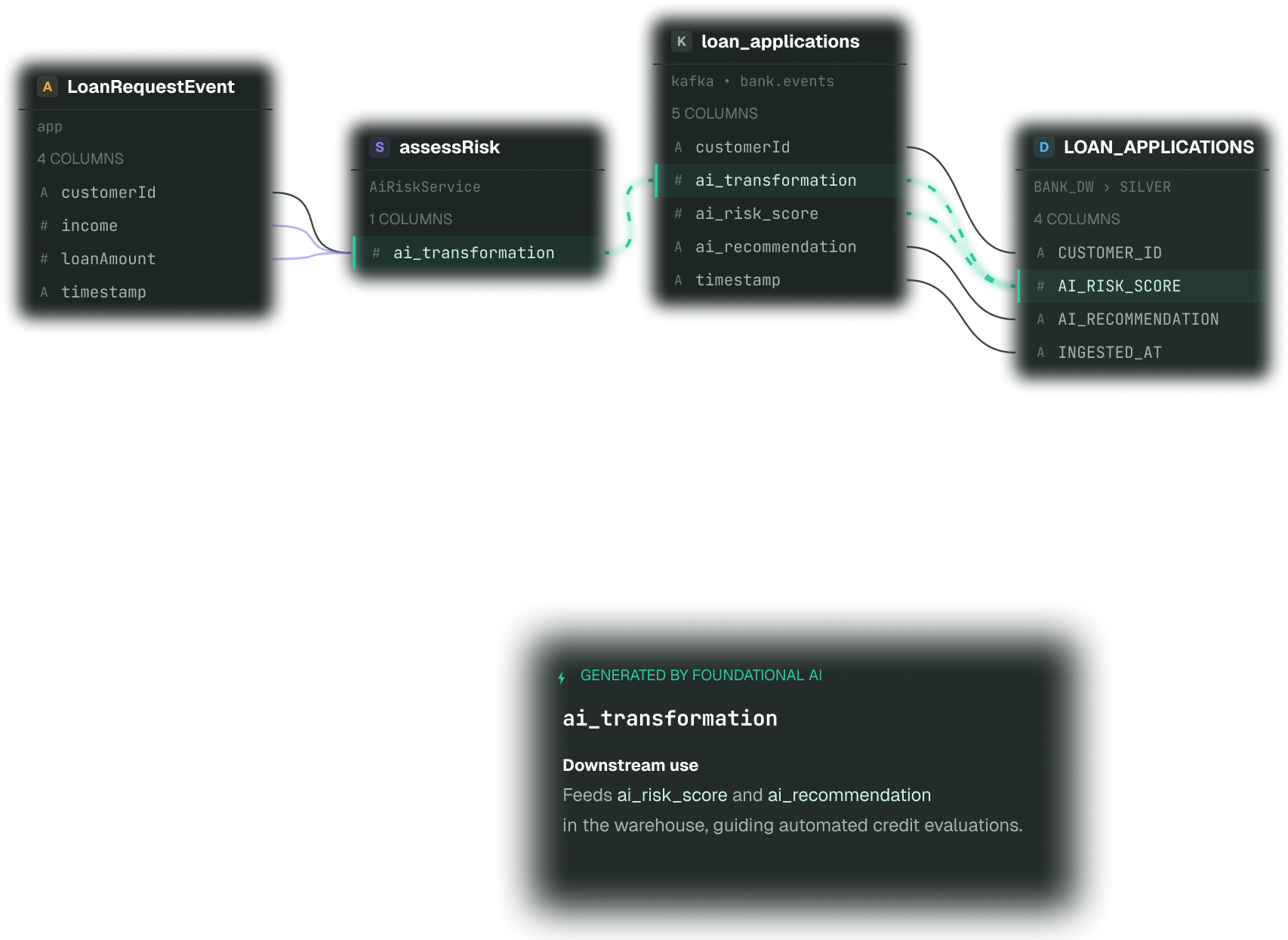
Foundational, a data and AI governance platform, analyzes source code directly rather than parsing warehouse query logs, so lineage extends upstream through Python pipelines, ORM layers, and application code before the data ever reaches a table. That is what separates governed data for AI from a catalog entry: the data's full path is documented in code, not reconstructed after the fact. At Lemonade, this approach to lineage and governance significantly accelerated regulatory approval for AI-driven underwriting decisions.
Most AI governance platforms stop at the data warehouse because they build lineage from query logs and metadata rather than from the underlying source code. Foundational is a data and AI governance platform built specifically to close that gap, analyzing Python pipelines, ORM layers, and application code directly so lineage extends back to where the data actually originated.
AI model governance is the set of practices and evidence that document what data fed a model, how that data was transformed, and who is accountable for it at each stage. It depends on lineage that reaches back through the full pipeline and application code that produced the model's inputs, not just the warehouse tables the model queried at training time.
Governed data for AI requires deterministic lineage from the point data originates, whether that is an application database, an API response, or a Python pipeline, all the way through to the model that consumes it. Without that full trace, a governance program can document policy but cannot prove the policy was followed for any specific model input.
A data catalog indexes and documents data assets that already exist in a warehouse or lake. An AI governance platform needs to do that and also trace how AI specific inputs, including engineered features and agent context, were produced, which requires visibility into pipeline and application code that catalogs do not analyze.
Most feature engineering for AI happens in Python, not SQL, which means lineage tools that only parse warehouse query logs miss the transformations that actually shape a model's inputs. Python pipeline coverage is what lets a governance program trace a feature back to its true origin instead of the table it happened to land in.
Complete AI governance platform coverage is not a checklist of features. It is the difference between being able to answer where a model's data came from and being able to prove it. For a CDO or VP of Data building an AI governance program from the ground up, that proof only exists if lineage extends through the Python pipelines and application code that catalog based platforms cannot see. See how Foundational's source code analysis delivers that coverage: request a demo.
Get a demo of source code level lineage for the pipelines feeding your AI models.
Get a demo of source code level lineage for the pipelines feeding your AI models.
Get a demo of source code level lineage for the pipelines feeding your AI models.