Automated Data Lineage Tools for Cross-Platform Lineage

Easily change dbt
/ See Looker impact before you merge

Foundational builds column-level lineage from your source code and connected metadata, so you see the impact of a change before you merge. Catch broken dashboards before a refactor ships.

Data Lineage interface showing flow from RAW_ORDERS with 12 columns in prod-db to ORDER_HISTORY and ORDER_INSIGHTS with 12 and 9 columns in prod-wh, then to SALES_OPPORTUNITIES with 3 columns in Looker, accompanied by database and data platform icons.
Lemonade LogoRamp LogoLightricks LogoPayjoy logoVioPagaya LogoUnderdog Fantasy Logo

Lineage that starts from source code

Lineage inferred from query history or runtime events only reflects work that has already run. Foundational reads the code in your repositories instead.
  • Reads SQL, Python, Java and the other supported languages and platforms, including assets that have never been queried.
  • Scans code on each pull request or merge request, and refreshes warehouse and BI metadata on a schedule.
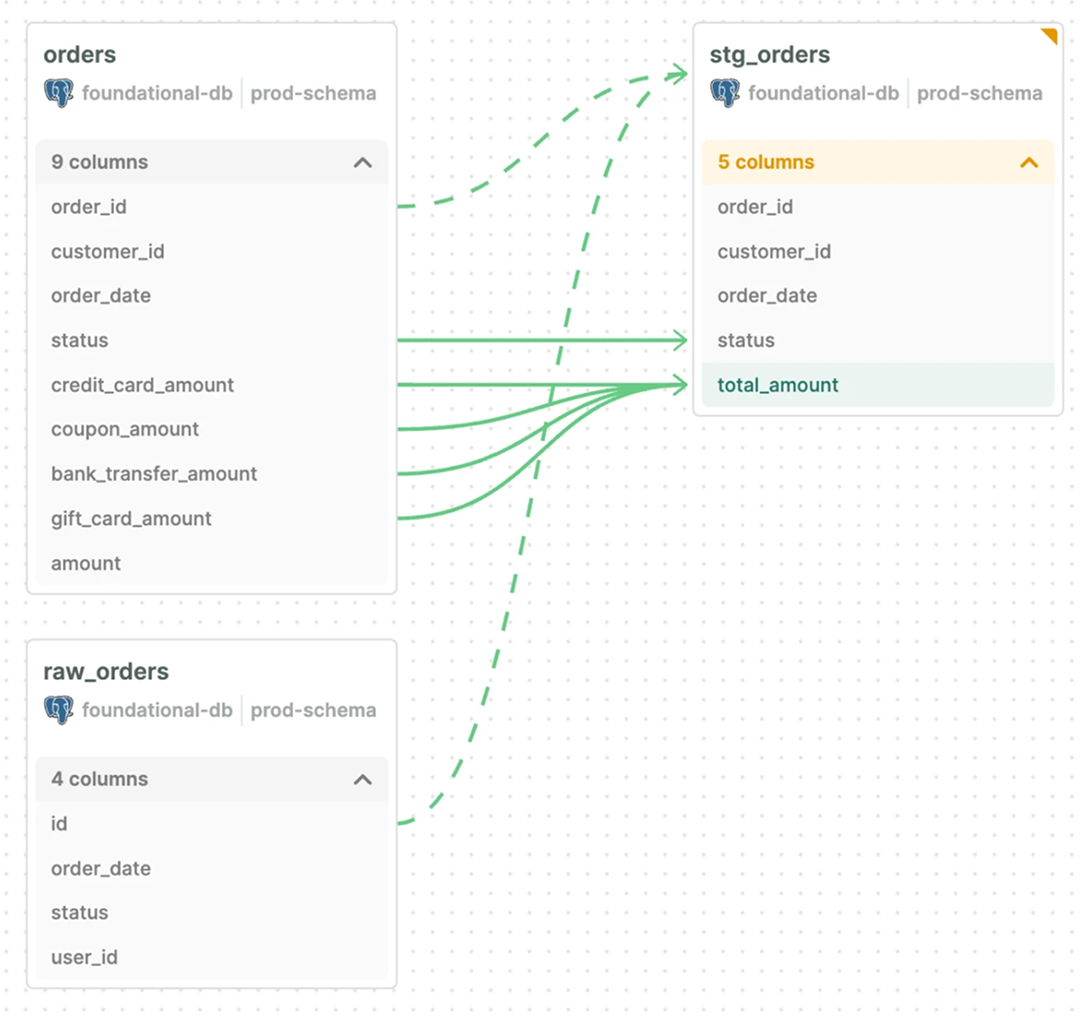
Database schema diagram showing three tables: orders with 9 columns, stg_orders with 5 columns, and raw_orders with 4 columns, connected by green arrows indicating data flow.
Column-level lineage into stg_orders: four orders amount columns feed total_amount, and status maps straight across.

What you can see, and where it helps

Once the data flow graph exists, engineering and governance teams can ask the same questions of it, like how a specific value is computed and used.

Column-level lineage across systems

Follow a column from its source through dbt models to the Looker, Tableau or Power BI dashboards that use it, with ownership and usage in the inspector.

Blast radius in the pull request

Foundational flags breaking changes, like a renamed column still used downstream, and can post the impact as pull request comments in GitHub, GitLab or Bitbucket.

See how your systems connect

A map of how your code, pipelines, warehouses and BI tools connect, so you can see what depends on what and how data flows between them. That map is complete lineage across the systems you already run.

Modernize and migrate with fewer surprises

See dependencies and unused assets before you move or retire a system, then check each change as it happens, so cutover brings fewer surprises.

Works with your stack

Foundational connects the tools you already use, from repositories to dashboards, in one data lineage platform.

Source control

GitHub, GitLab, Bitbucket and Azure DevOps.

Pipelines and transformation

dbt, Spark, Airflow, Fivetran and Azure Data Factory.

Warehouses and databases

Snowflake, BigQuery, Redshift, Databricks and PostgreSQL.

BI tools

Looker, Tableau, Power BI, Sigma and Metabase.
“Foundational gave us instant clarity on our data. With column-level lineage, we stopped wasting hours chasing data lineage and started fixing issues before they became problems.”
Eyal El-Bahar, VP of BI and Analytics
"A data change can impact things your team may be unaware of, leading folks to draw potentially flawed conclusions about growth initiatives. We needed a tool to give us end-to-end visibility into every modification.”
Iñigo Hernandez, Engineering Manager
“With Foundational, our team has a secure automated code review and validation process that assures data quality. That’s priceless.”
Omer Biber, Head of Business Intelligence
“Foundational has been instrumental in helping us minimize redundancy and improve data visibility, enabling faster migrations and smoother collaboration across teams.”
Qun Wei, VP Data Analytics
“Foundational helps our teams release faster and with confidence. We see issues before they happen.”
Analytics Engineering Lead

See how a change would land, before it merges

Get a walkthrough of the data flow graph and the impact comment on your pull requests, across the platforms you use.

Frequently asked questions

What are data lineage tools?

Data lineage tools show how data moves, changes and gets used across systems, so you can see which tables, dashboards or jobs depend on a column. Automated ones build and refresh that graph so nobody has to draw it by hand.

Foundational builds it from the source code in your repositories, including assets that have never been queried, then merges warehouse and BI metadata.

What is cross-platform lineage?

It's a single graph that covers more than one kind of system, such as transformation code, a warehouse and a BI tool, instead of stopping at one platform's boundary.

In Foundational, the graph is built from source code and from metadata for the warehouses and BI tools you connect, such as dbt, Snowflake and Looker.

Are Foundational's data lineage tools open source?

No. Foundational is a commercial product, not an open-source lineage tool, though it works with an open standard.

It can ingest OpenLineage events from pipelines that emit them, and export its own lineage in OpenLineage format for catalogs and other tools that read it.

Can cross-platform lineage tools show the impact of a change before it merges?

Yes. When you open a pull request on a connected source-control host, Foundational finds which connected assets are added, modified or removed, and can post that impact on the PR.

The comments appear in GitHub, GitLab or Bitbucket, next to the code change.

Which tools does Foundational's cross-platform lineage work with?

It reads code in SQL, Python, Java, Scala, COBOL and other languages, and connects to GitHub, GitLab, Bitbucket and Azure DevOps. It works with pipeline and transformation tools such as dbt, Spark, Airflow and Fivetran.

For warehouses and BI, it works with Snowflake, BigQuery, Redshift, Databricks, Looker, Tableau and Power BI, among others on the supported languages and platforms list.

Governance that starts at the source.